Working with Letters and Sounds: Starting with the Alphabet

Emergent readers and writers need to learn the letters of the alphabet and their names. They also need to learn the sounds that letters make – starting with the most common sound for each letter. The guidelines below are designed to help you decide where your student(s) are at, and then provide appropriate intervention for their level.
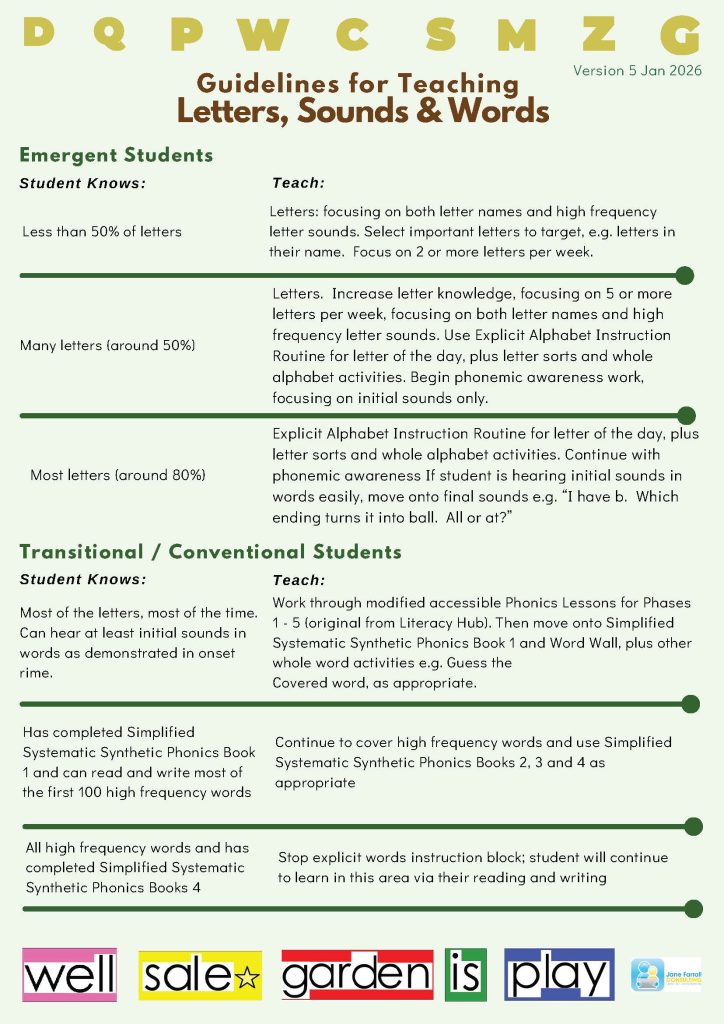
The Working with Letters, Sounds and Words Continuum presents similar information in a different layout, with a row for writing the names of each student. The continuum also includes information about learning goals and strategies.
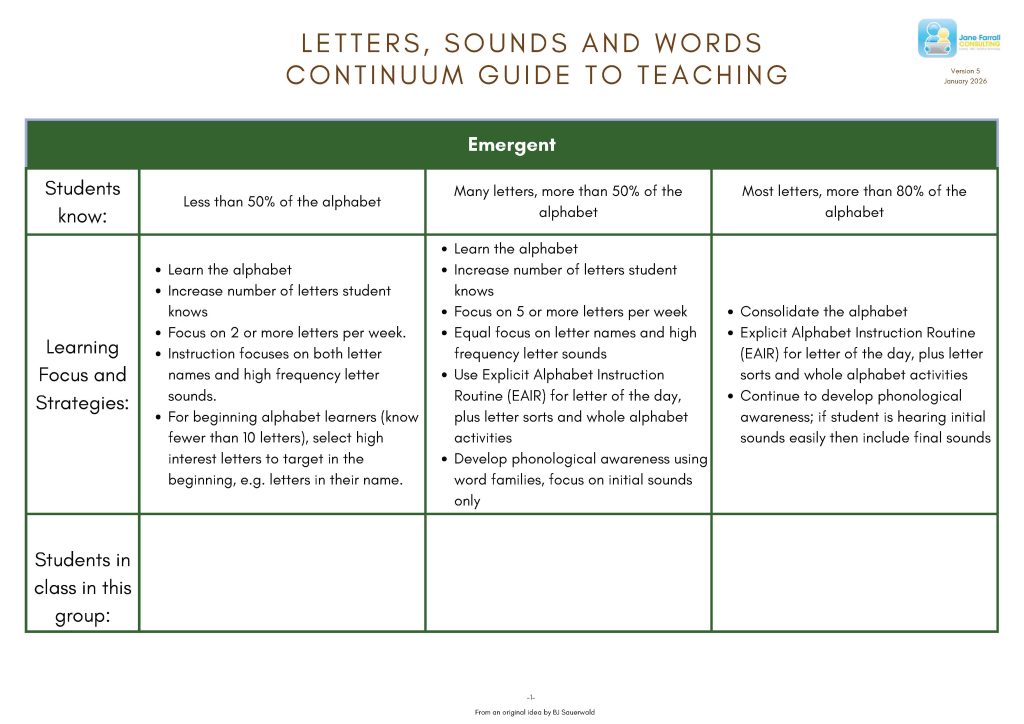
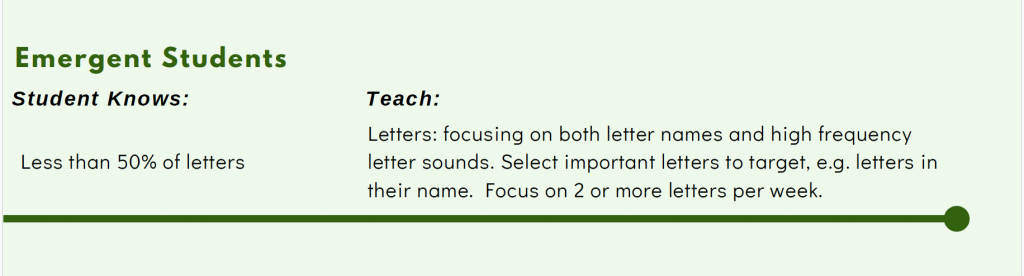
Early emergent students are at the beginning of their alphabet learning. They need instruction with a focus on letter names. Letter names provide a single label for each letter which makes it easier for the students to learn the alphabet than letter sounds. Letter names have “a single mnemonic peg to hang the letter shape on” whereas letter sounds can have multiple labels for a letter.
We should always target at least two letters of the week. All the research into this area shows that a single letter of the week is not effective. This is partly because targeting a single letter of the week means students don’t have to think about the letters – if our letter of the week is ‘b’ and we ask a student “which letter does bus start with” then they don’t have to think about it. However, if we have two letters of the week, for example ‘b’ and ‘m’, and we ask the same question, the student has to think to answer it, which results in more learning. Additionally, it is easier to learn about the characteristics of ‘b’ when we compare it with ‘m’ – one is tall and the other is short. One has a short, plosive sound and the other has a longer sound that vibrates when we say it, etc.
There is no set order for teaching the alphabet. However, here are a couple of handouts about selecting which letters to teach:
- Considerations for choosing letters of the week by Sally Clendon
- Deciding on which letters to teach by Nick Drover
It is important that we realise that some students will be learning the alphabet for a while and we need to have enough different activities to keep engaging them. Alphabet sorts are a really valuable activity because they require students to think and discriminate but they are only one example of activities we should do with the alphabet. Teaching (and Learning) the Alphabet: Playing with Letters Shapes and Sounds is a blog post that will give you some ideas – and there are also lots on Pinterest and on TeacherPayTeachers.
The handout below runs through the range of letter and sound activities that should be used throughout a week with students at this level – and the other pages provide an example of a weekly program.
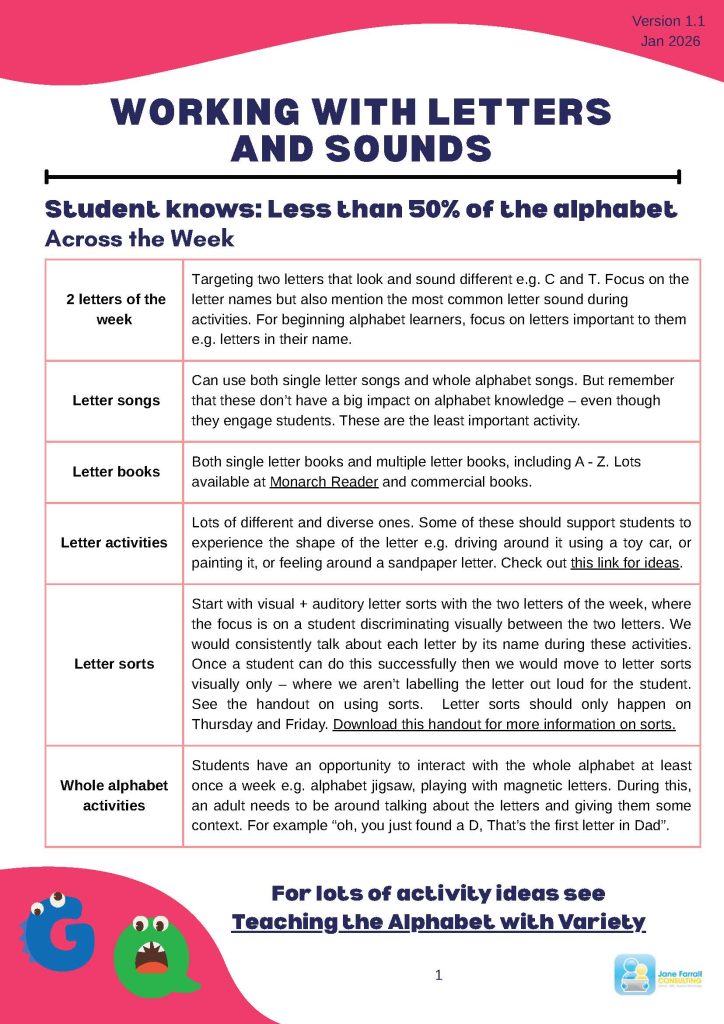
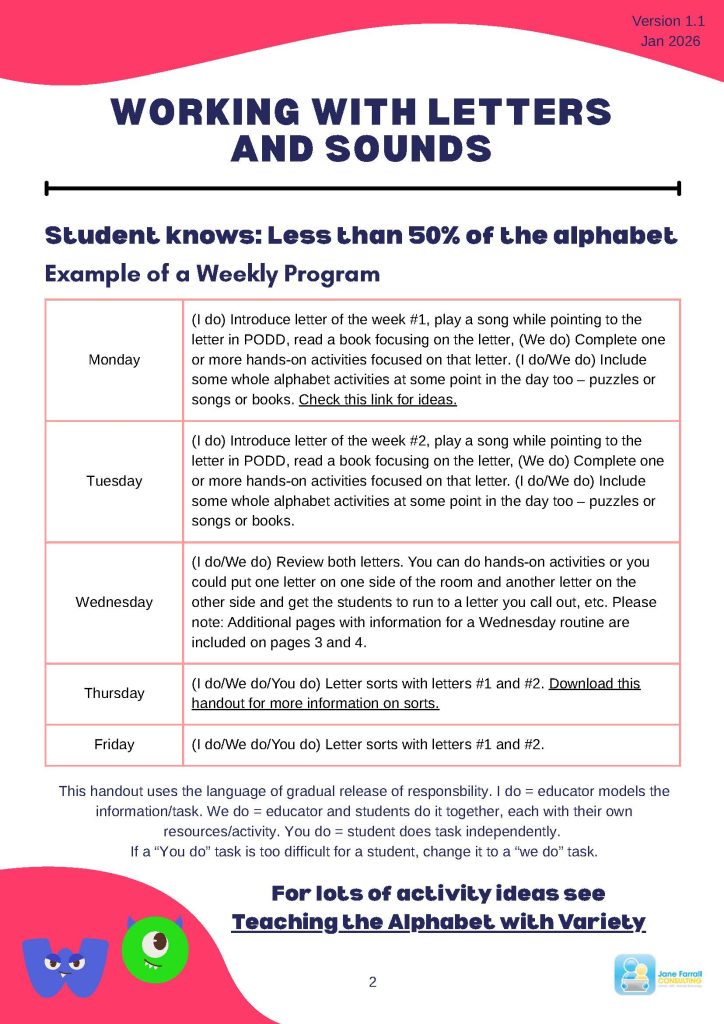
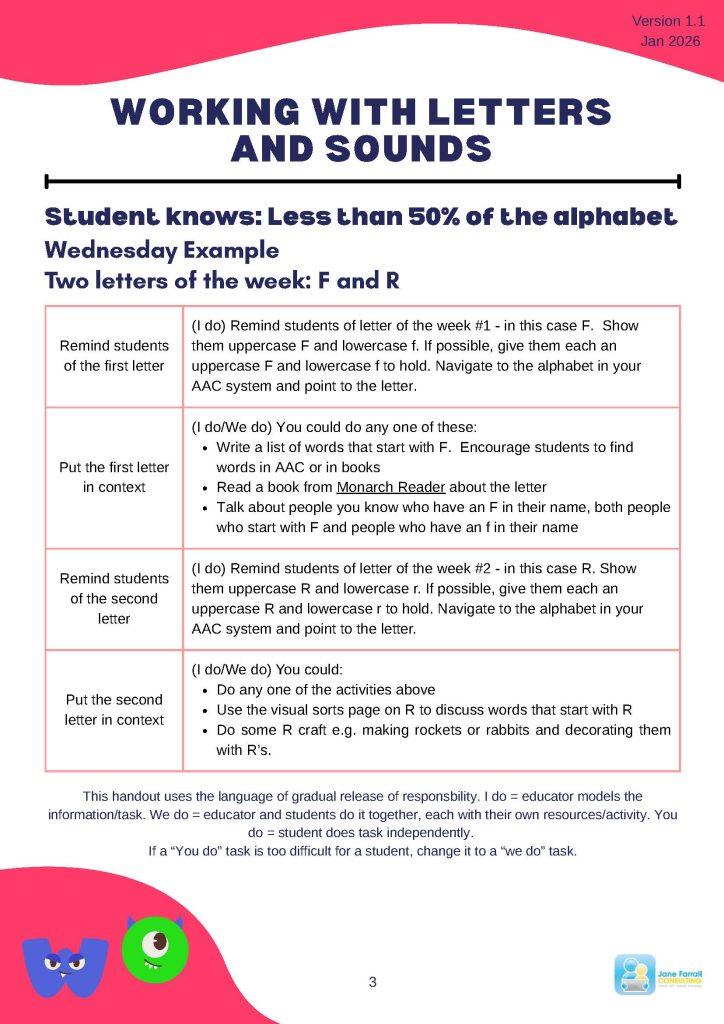
For some more information about using Letter Sorts as referenced in the handout, please see the section on letter sorts below.
Alphabet Resources to Download
Here’s some example alphabet activities you can download. If you need resources for a student with CVI and/or physical disability, see the section below.
- Alphabet Books from Monarch Reader (one for every letter of the alphabet, see below for high contrast)
- Transport Alphabet book from a student (added October 2026)
- Alphabet Pages with letter hunts (new January 2026)
- Coloured Alphabet cards, upper and lower case
- Clownfish alphabet (new May 2025)
- Double Decker bus alphabet (new May 2025)
- Roses alphabet (new May 2025)
- Thomas the Tank Engine alphabet (new May 2025)
- 26 A4 Alphabet sheets
- ABC Bingo Upper case (new Jan 2023)
- ABC Bingo Lower case (new Jan 2023)
- ABC simple Book for making your own classroom alphabet book (updated Jan 2023)
- Visual Word Sorts (sorting pictures by the first letter in their label; updated Jan 2026)
- Simple letter sorts – three examples of simple letter sorts
- Kmart letter puzzles – Some great alternative templates to print and use with the Kmart Alphabet Puzzle from Eleanor at Springvale Park SDS. These are awesome for students who need to learn the alphabet doesn’t have to go from A – Z.
Activities to go with the Letters and Sounds Cards
- Letters and Sounds Cards
- Alphabet Dough Mats
- Dot letters
- Large grey letters
- Letter Roads
- Letter sorts multi-coloured (see below for high contrast version)
- Letters sorts monochrome
- Alphabet scrapbook template
- Outline letters
- Planning sheet for using the cards
Students with CVI and Physical Disability
Many teachers ask about letters and sounds activities for students at a similar level of alphabet knowledge who have a cortical vision impairment and who may not be able to use their hands to manipulate alphabet activities. The handout below runs through suggested activities across a week and then offers a detailed weekly plan on pages 2, 3 and 4.
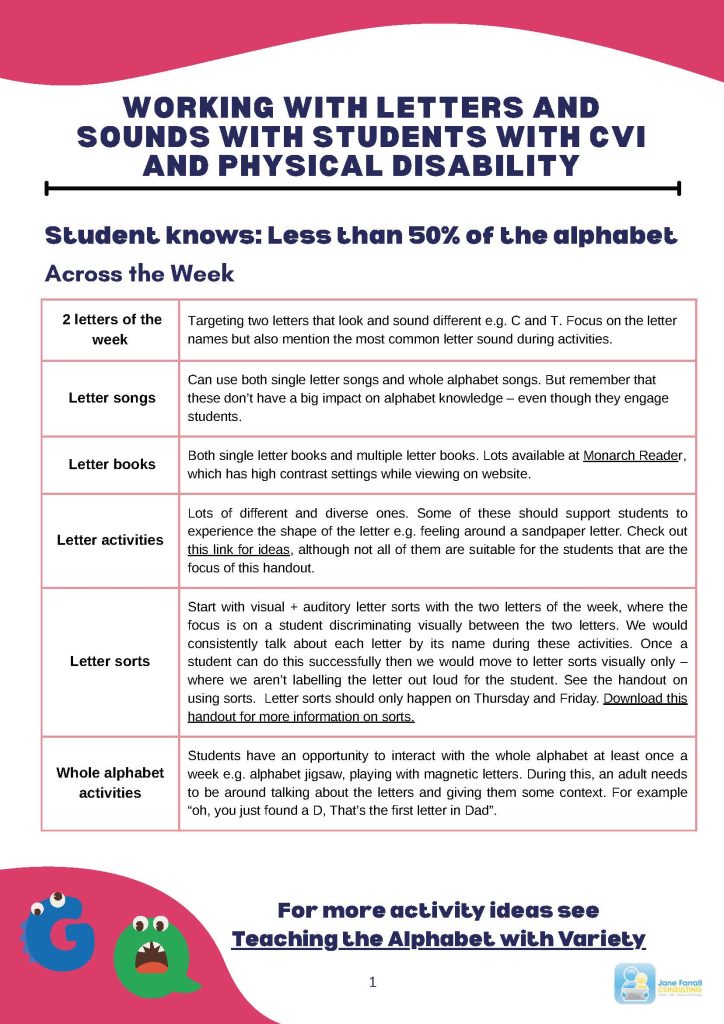
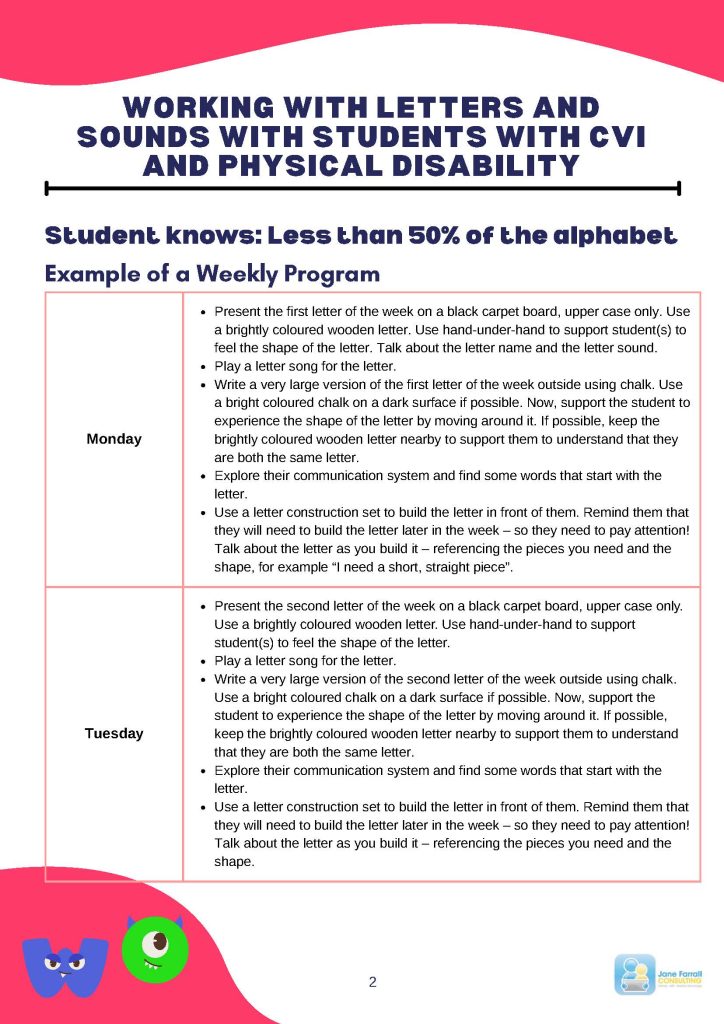
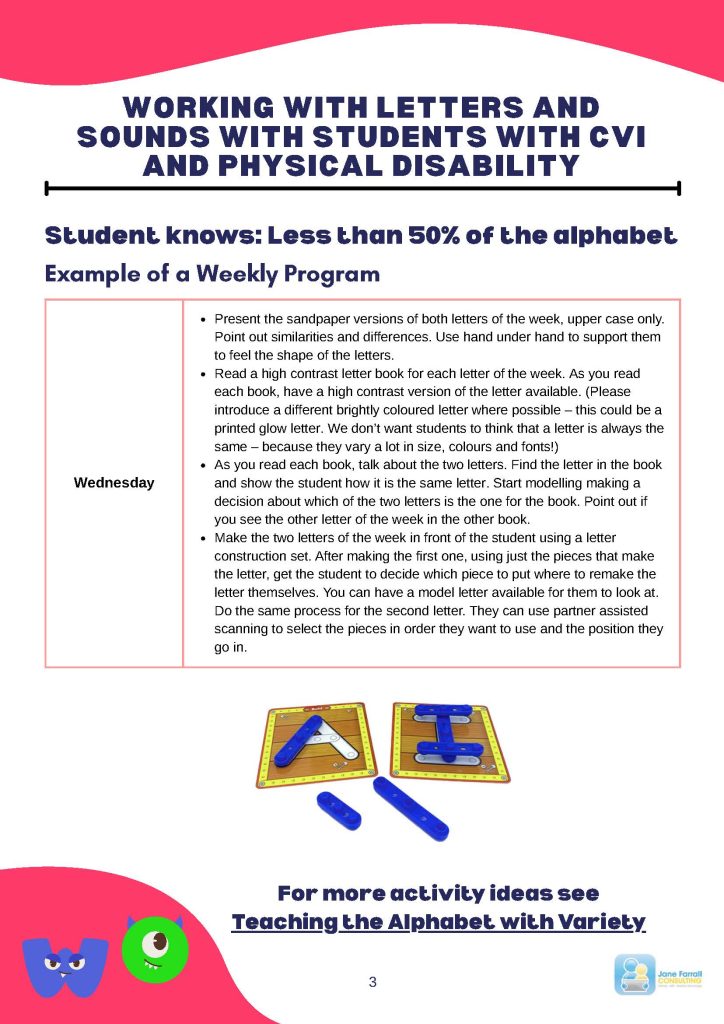
Alphabet resources for students with a Cortical Vision Impairment and physical disability
- High Contrast Alphabet cards, upper case, multi coloured letters on black (added October 2025)
- High Contrast Alphabet cards, lower case, multi coloured letters on black (added October 2026)
- High Contrast Alphabet cards, upper case, multi coloured glow on black (added October 2025)
- High Contrast Alphabet cards, upper case, Yellow on black (added October 2025)
- High Contrast Alphabet cards, upper case, Yellow Glow on black (added October 2025)
- High Contrast Alphabet cards, upper case, Green on black (added October 2026)
- High Contrast Alphabet cards, lower case, Green on black (added October 2026)
- High Contrast Alphabet cards, upper case, Green Glow on black (added October 2026)
- Roman Bubble Alphabet
- Letter sorts high contrast
Alphabet Books from Tar Heel Reader in High Contrast
- A to F High contrast
- G to L High contrast
- M to R High contrast
- S to W High contrast
- X to Z High contrast
Our Alphabet Book template (high contrast)
Letter Sorts for Students who Know Less than 50% of the Alphabet
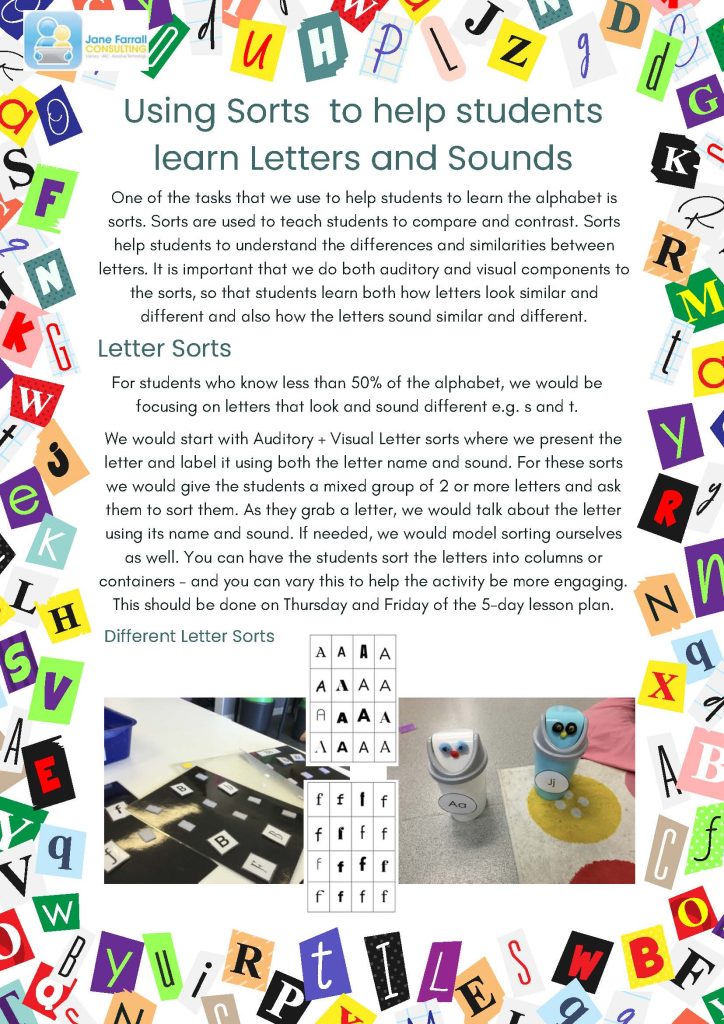
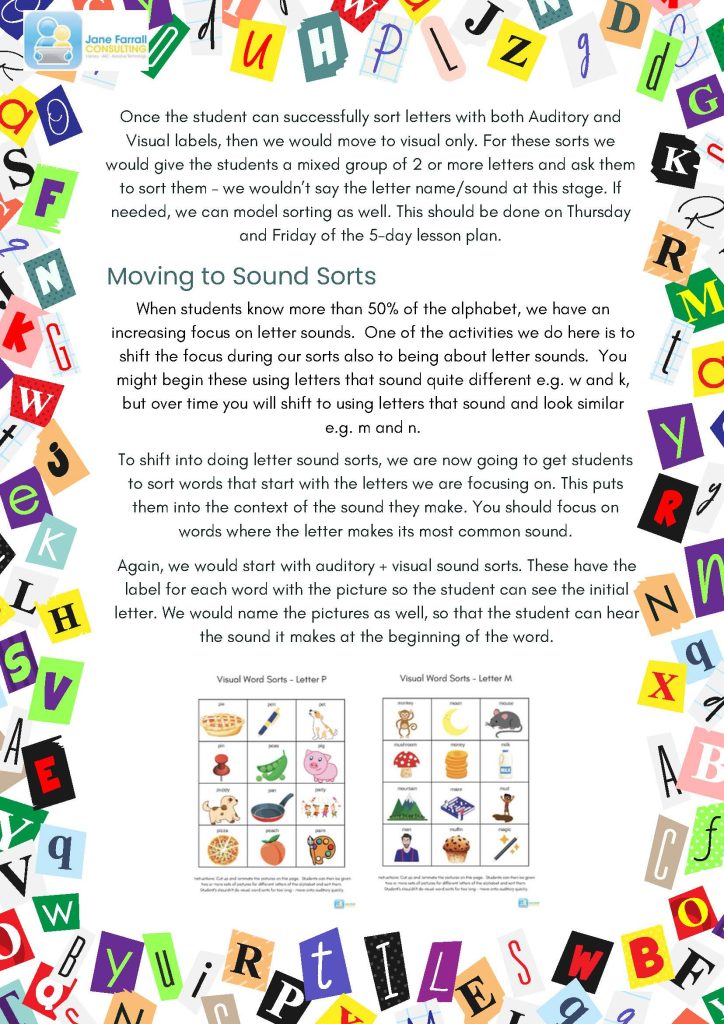
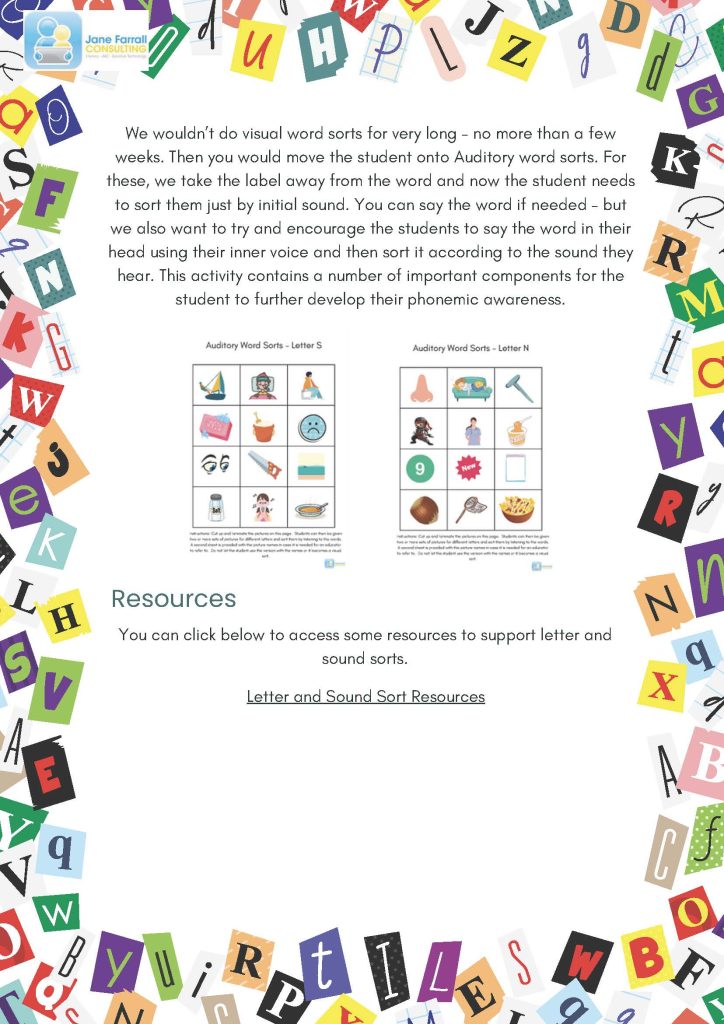
The handout above takes you through further information about alphabet sorts. For students who know less than 50% of the alphabet, we would focus on letter sorts. The files below can be used to create letter sort bags for use in this activity.
Files for letter sorts:
- Letter sorts (black letters on white background)
- Letter sorts (multi-coloured letters on white background)
- Letter sorts (high contrast)
- Labels for Sorting Containers
Letters and Sounds Record form
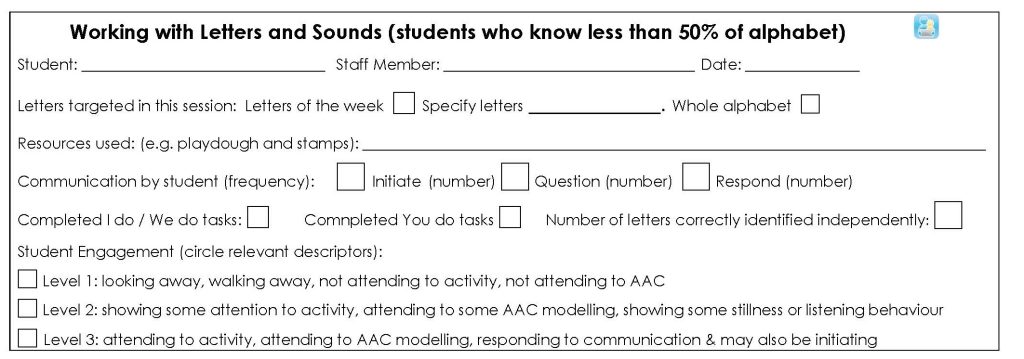
- Letters and Sounds Record Form (for students who know less than 50% of the alphabet)
- Guide to completing the Letters and Sounds Record form
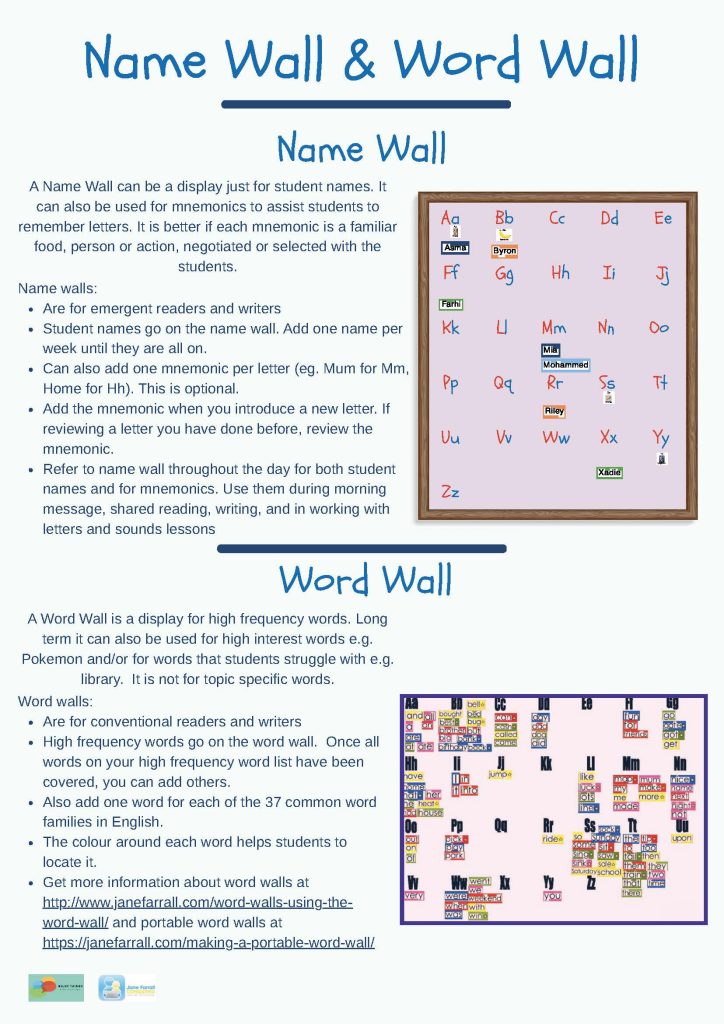
Name Wall & Word Wall handout
Sometimes we get questions about the difference between a name wall (for emergent students) and a word wall (for conventional students). The handout below explains the differences.
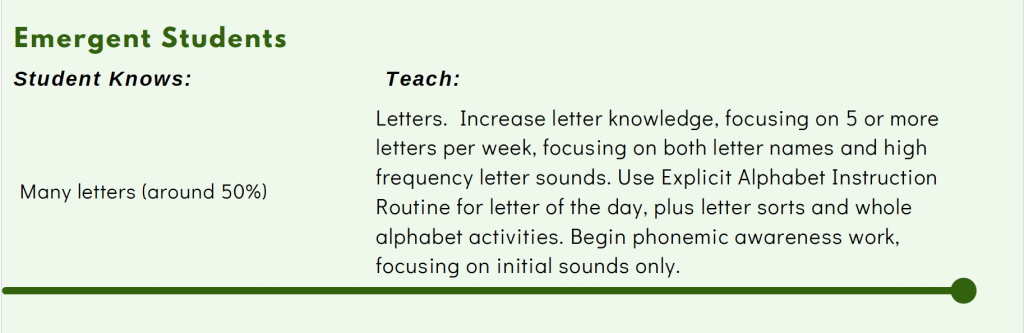
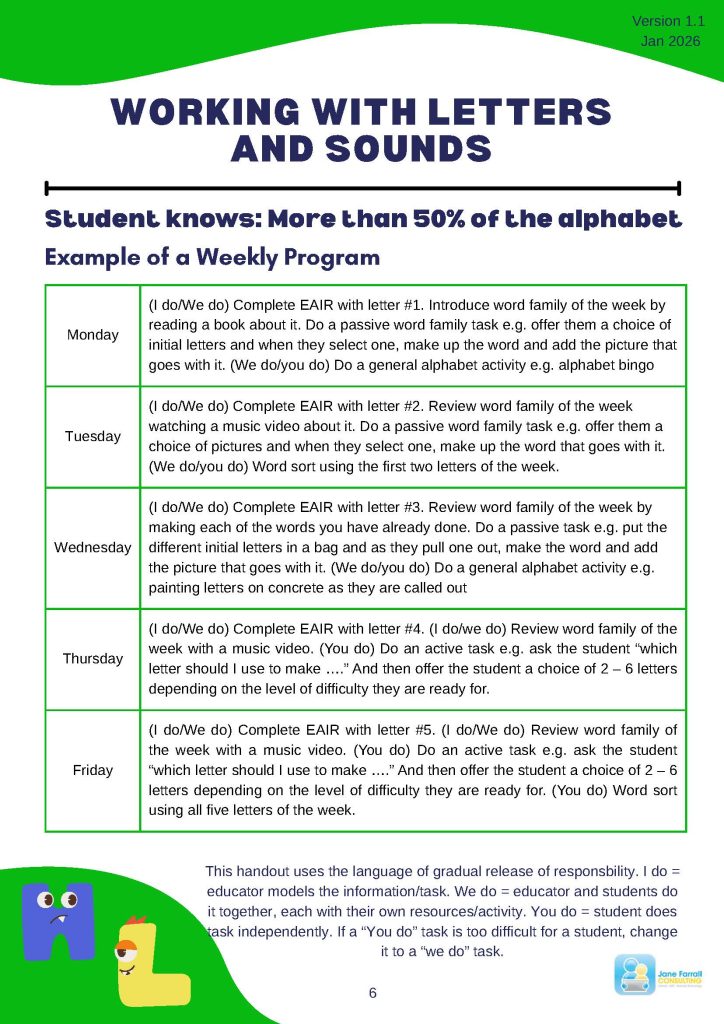
Emergent Students who know more than 50% of the alphabet need to continue with alphabet instruction – but we would increase to 5 letters per week and use the Explicit Alphabet Instruction Routine to focus on a letter per day. During the week we also need to build in some activities that ask the student to sort letters as well, using the 5 letters of the week.
The handout below runs through the range of letter and sound activities that should be used throughout a week with students at this level – and on the second page provides an example of a weekly program.
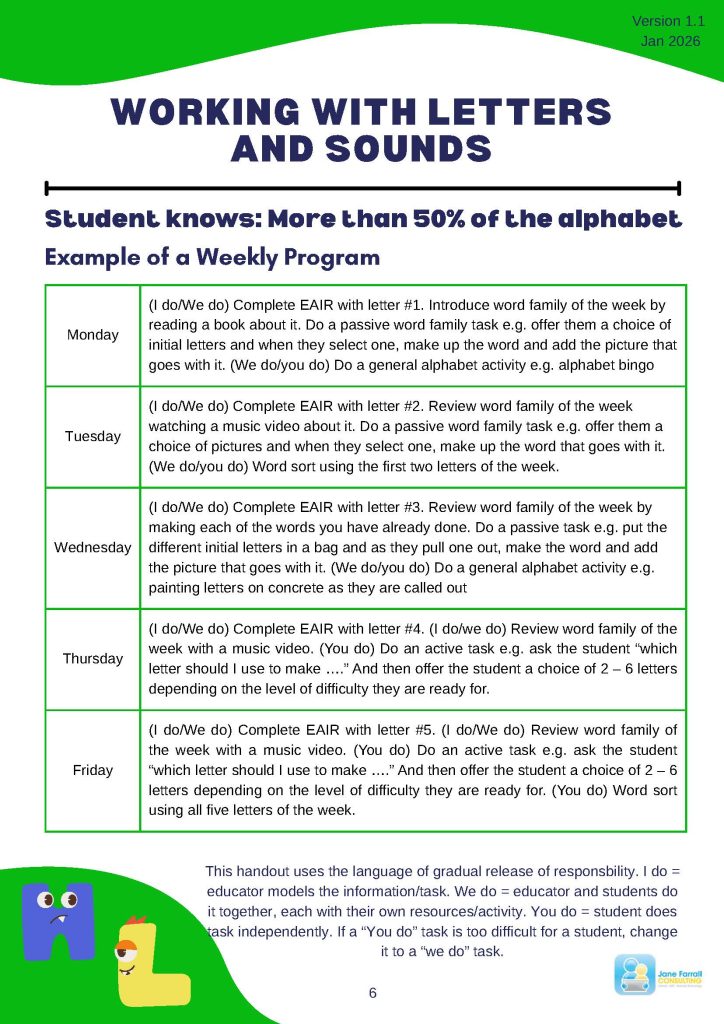
Explicit Alphabet Instruction Routine
The Explicit Alphabet Instruction Routine (EAIR), also known as Enhanced Alphabet Knowledge (EAK), was developed as a way to efficiently consolidate alphabet knowledge with students in their first year at school. It moves quickly through the alphabet, focusing on a letter per day. Part of the routine is a script that you follow each day, moving through the alphabet 6 times in a different order – these are known as the 6 cycles. The original program was designed to be done with large groups, but we are often implementing it with small groups. For this reason the cycle guide suggests a review at the end of cycle 2. Once you are confident that all your students know a specific letter e.g. G, then you can remove it from future cycles.
A range of resources for implementing the EAIR are below:
- Script for the Explicit Alphabet Instruction Routine modified for students who use AAC or who need additional supports
- EAIR Cycle Guide – handout explaining the 6 cycles and which order to do the alphabet in each cycle. Updated May 2025
- Letter Sounds Guide – during the alphabet routine we refer to the letter using both the letter name and the most common letter sound. This is a PowerPoint I created that talks you through the most common sound for each letter
- EAIR Script letter by letter
- Count letters spreadsheet for the First cycle
- EAIR Record Form
Letter Sorts for Students who know more than 50% of the alphabet
- Letter sorts handout
- Visual word sort sheets (Auditory + Visual to be used for a short time only)
- Auditory word sort sheets (Auditory only)
Phonemic and Phonological Awareness
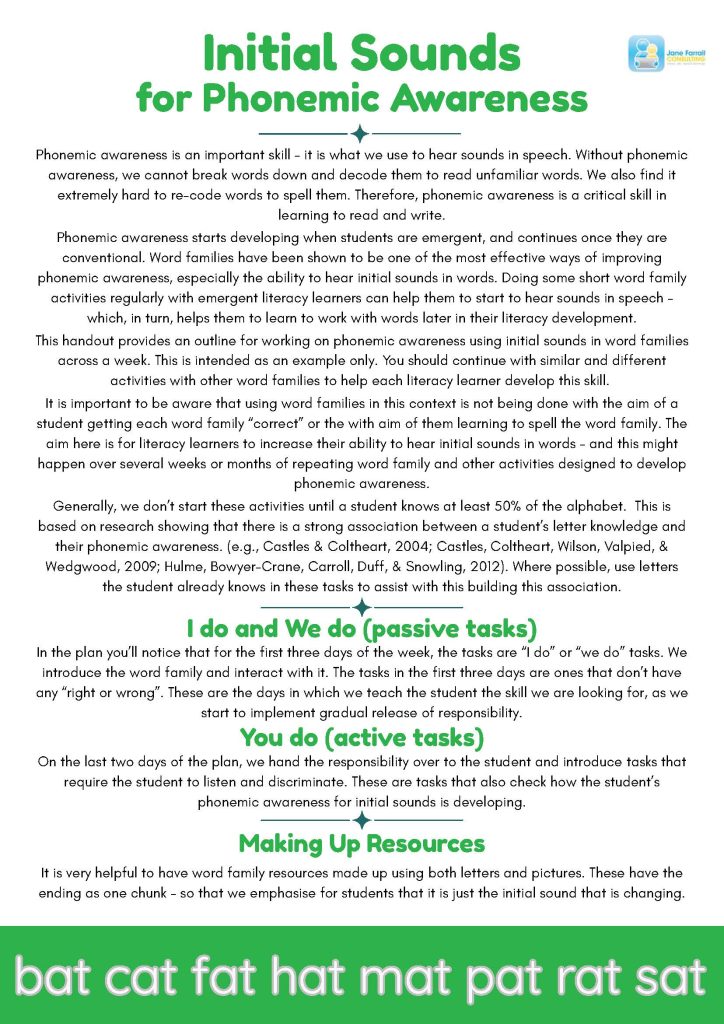
Emergent students who know more than 50% of the alphabet should also be doing phonological and phonemic awareness activities. We are aiming to help students hear that speech is made up of smaller pieces – words, syllables and sounds. Individuals with complex communication needs are particularly at risk for having difficulty in developing these skills so we need to be proactive and target this skill explicitly. There are some general activities you can do to encourage this included in the files below, but the most important is onset rime.
Onset rime has been shown to be one of the most effective strategies we can use to build phonemic awareness. Children with CCN may have difficulties developing phonemic awareness so we usually start tackling this once a student knows about half the alphabet.
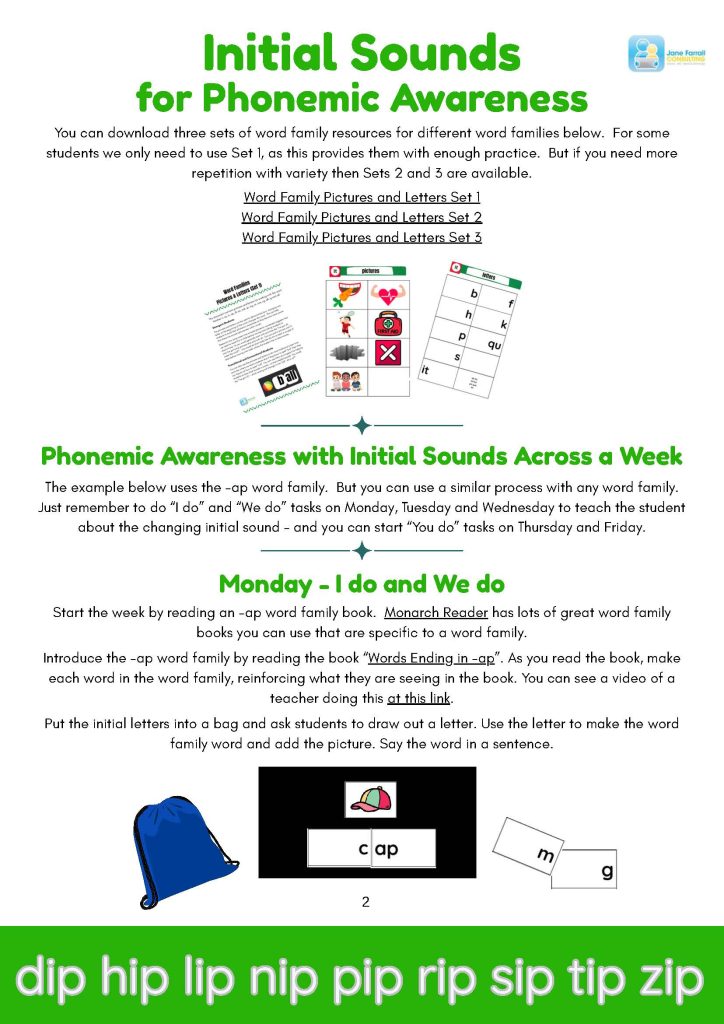
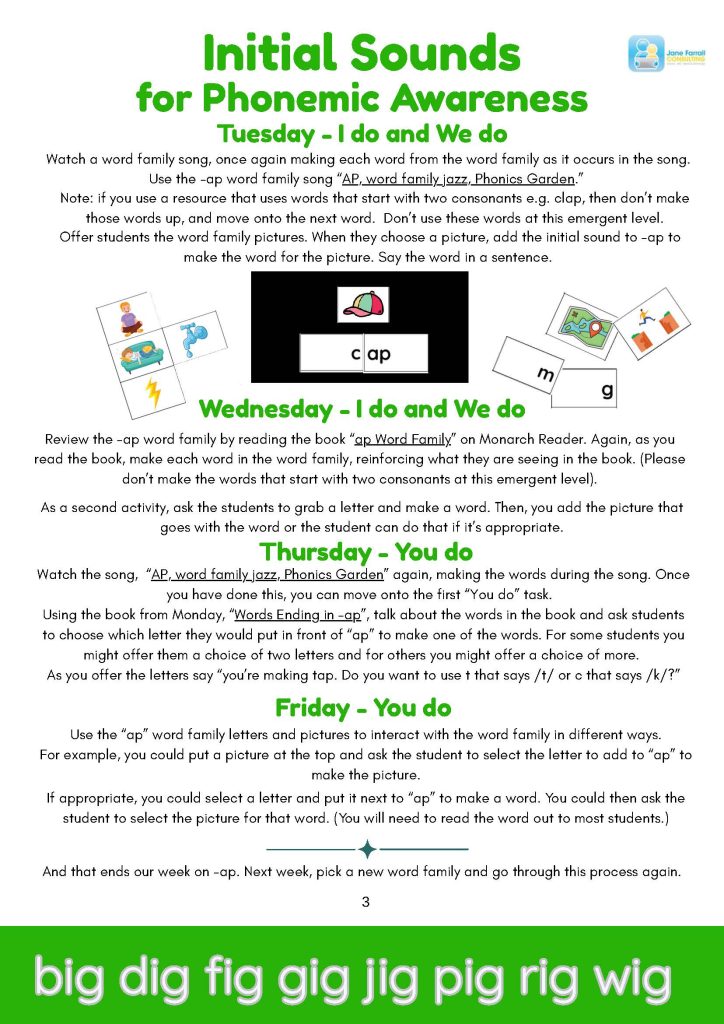
The handout below provides further information about word families and also provides an example of a week of using word families for phonemic awareness.
As well as the handout above, I have also created an app for working on onset rime. At this stage, it only covers 15 word families, but over time it will expand. You can access it at https://wordfampa.com/.
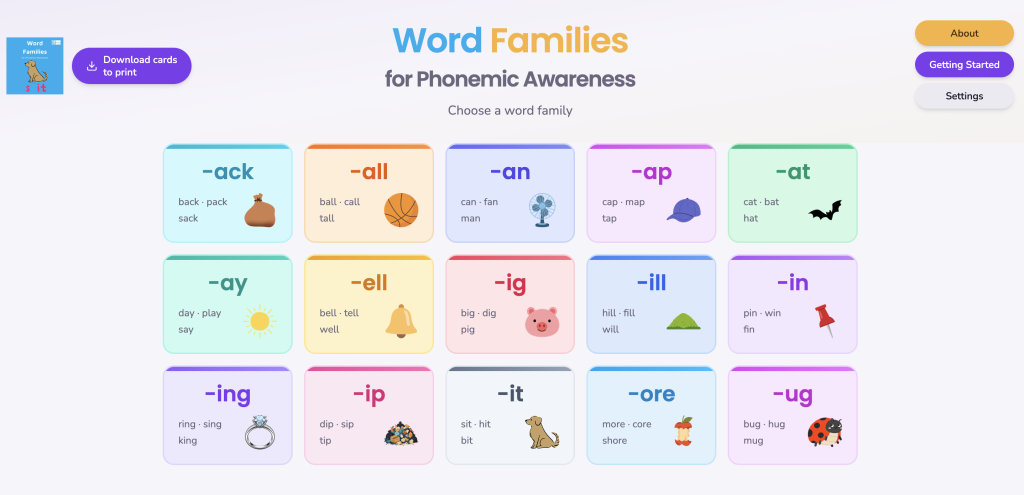
As well the the website, I have provided a 15 week program for using it, to support students.
You can also download or print all resources from the website to create non-electronic resources if needed. Alternatively, there are a bunch of options below.
Word Families for phonemic awareness handout (shown above; updated in January 2026)
Word family picture kits. These go through each word family, providing pictures as well as letters to do onset rime activities.
- Set 1 (easiest word families)
- Set 2
- Set 3
- Word family folders – three onset rime folders, similar to the one being used in the video below (please note: we are getting a lot more success with the picture kits above than the letters only)
The video below shows a teacher reading an word family book and using the folder to draw attention to the word family.
Additional Activities
Love & Reilly (2009) published a book called A Sound Way which includes a range of activities for improving phonological and phonemic awareness. Some of the activities in this text will need modifications to be used with individuals with Complex Communication Needs (CCN) and example modified activities are below – both from A Sound Way and other sources. Please note: there is growing research that phonemic awareness is the most important skill for literacy development. At this stage, we are not sure how much this applies to students who need AAC.
Example Phonological and Phonemic Awareness Activities for Students who need AAC
- Auditory word sorts – similar to the visual sorts above, but in this version there are no labels for the pictures. students need to listen to the words and sort by initial sound (updated Jan 2023)
- Rhyme in Threes – students need to pick the word that rhymes from the second row and move it up to the gap in the second row (created October 2021)
- Eye Spy Sounds – using the pictures on the page, play “I spy with my little eye, something beginning with….” (created October 2021)
- Sound Scavenger Hunt – each sheet is accompanied by pictures which can be placed around a room and then students can do a sound based scavenger hunt (created October 2021)
- Animal Rhymes – find the animal in the group of three at the bottom that rhymes with the animal at the top (created October 2021)
- Animal Rhymes High Contrast – same as above in high contrast (Created August 2024)
- Rhyming Pictures – draw a line between two pictures that rhyme (created October 2021)
- The Longest Word – listen to the words and pick the longest one (created October 2021)
- Word Puzzles – which two shorter words go together to make a longer word? (created October 2021)
- Rhyme Bingo – cards to print (created June 2025)
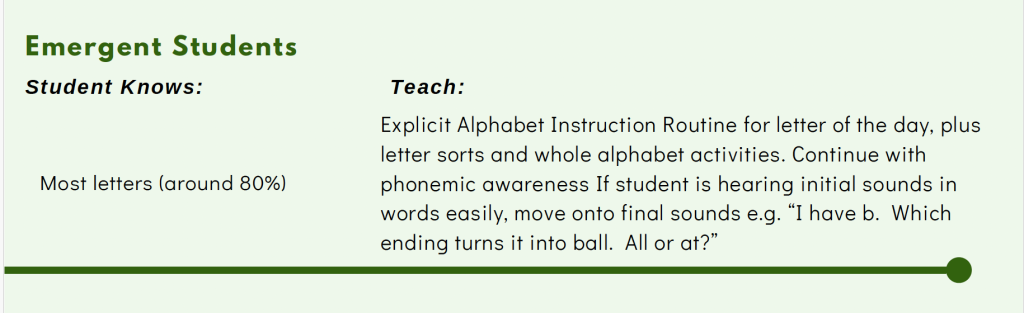
Late emergent students know a lot of the alphabet and need to work on consolidating their knowledge. Continue to use the Enhanced Alphabet Routine Script (Jones, Clark & Reutzel, 2013) if the student is still consolidating letter names and sounds. By this stage, you would only do the script with the letters they still need to learn. You may also concentrate on pairs that they confuse by either sound or appearance e.g. m and n as per the guidelines in Cycle 6.
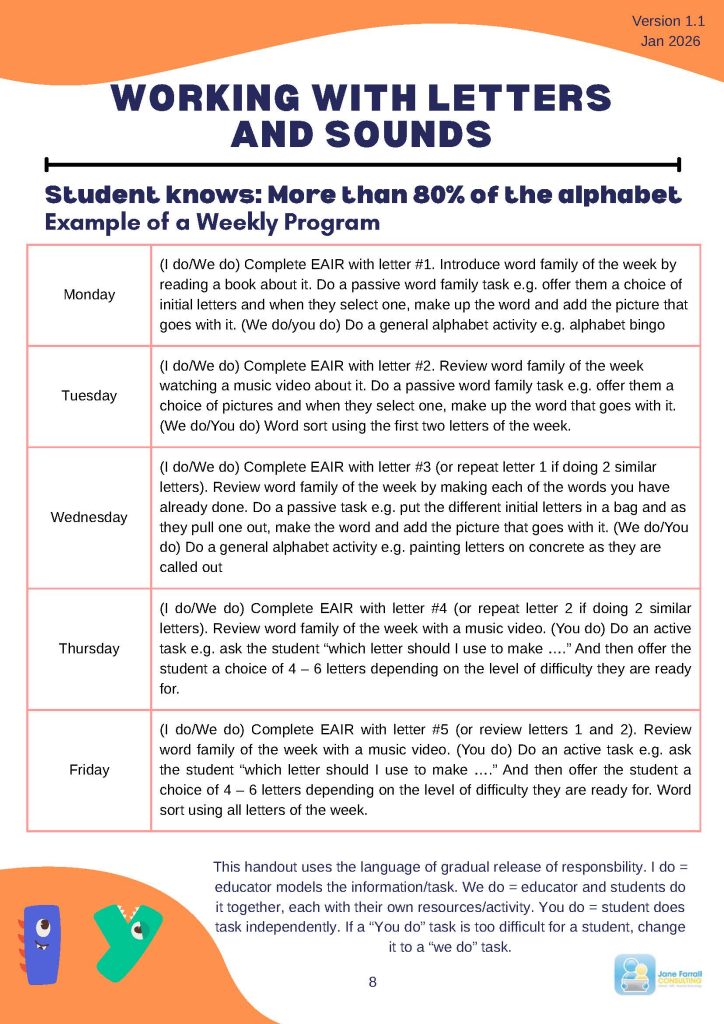
The handout below runs through the range of letter and sound activities that should be used throughout a week with students at this level – and on the second page provides an example of a weekly program.
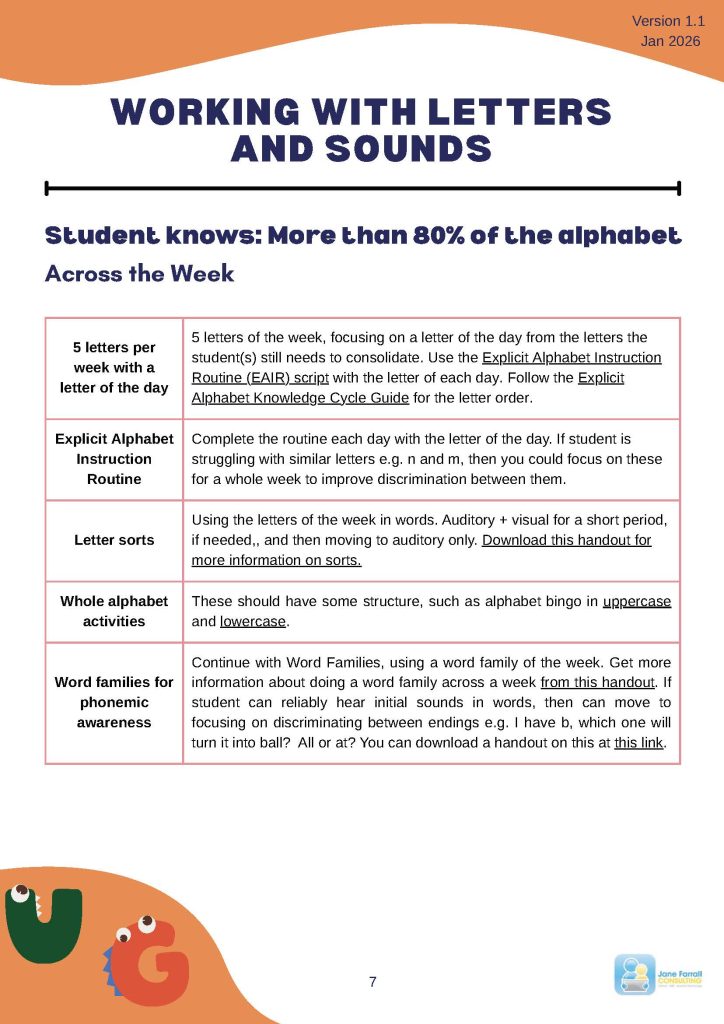
For these students, also make sure you continue with work on onset rime. If the student is hearing initial sounds in words easily, then move onto final sounds.
If you are working on final sounds in onset rime, here are some resources
- Phonemic Awareness of Final Sounds handout (new December 2025)
- Set 1 of letters and pictures
- Set 2 of letters and pictures
Working with Letters and Sounds – Other Resources
Working with Letters, Sounds & Words in our Classrooms Overview Sheet
- Working with Letters, Sounds & Words in our Classrooms Overview Sheet (Updated August 2025)
Working with Letters, Sounds and Words Self-Evaluation Forms for Educators
- Printable Letters, Sounds and Words self-evaluation or observation form (modified February 2024)
- Fillable Letters, Sounds and Words self-evaluation or observation form
- Engaging and Interactive Activities From Staff (a simpler form, which some schools have used with teacher aides or teachers)