Independent Writing: Authentic & Independent Student Voice

Conventional literacy learners should be working on writing independently or already writing independently. Whatever level they are at, to help them progress with their writing, we should model writing and activate any needed background knowledge before asking the students to write. Evidence shows that modelling good writing is the most successful way to help students to become better writers. We usually write in front of them. As we do this, we might model “thinking out loud” or “using the word wall” or “sounding it out” or other features of writing. Initially we often focus on “thinking out loud” as as we generate ideas and language. For early conventional writers, we prioritise modelling “thinking out loud” as it teaches them to think like a writer.

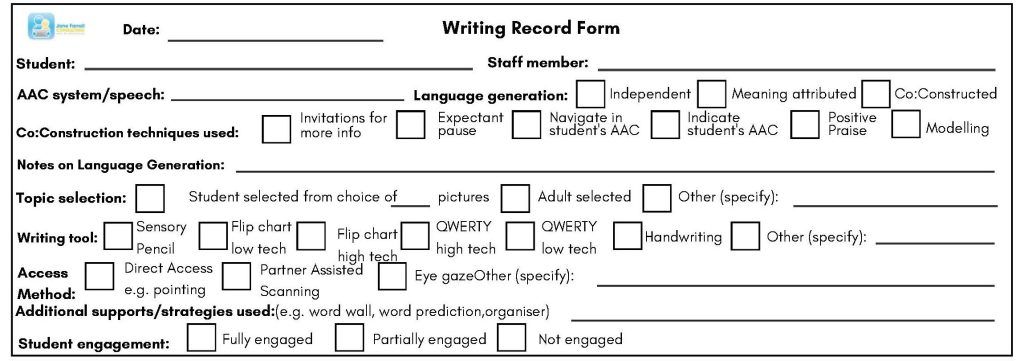
Until a student is completely independent, we would continue to fill out a writing record form each time they write.
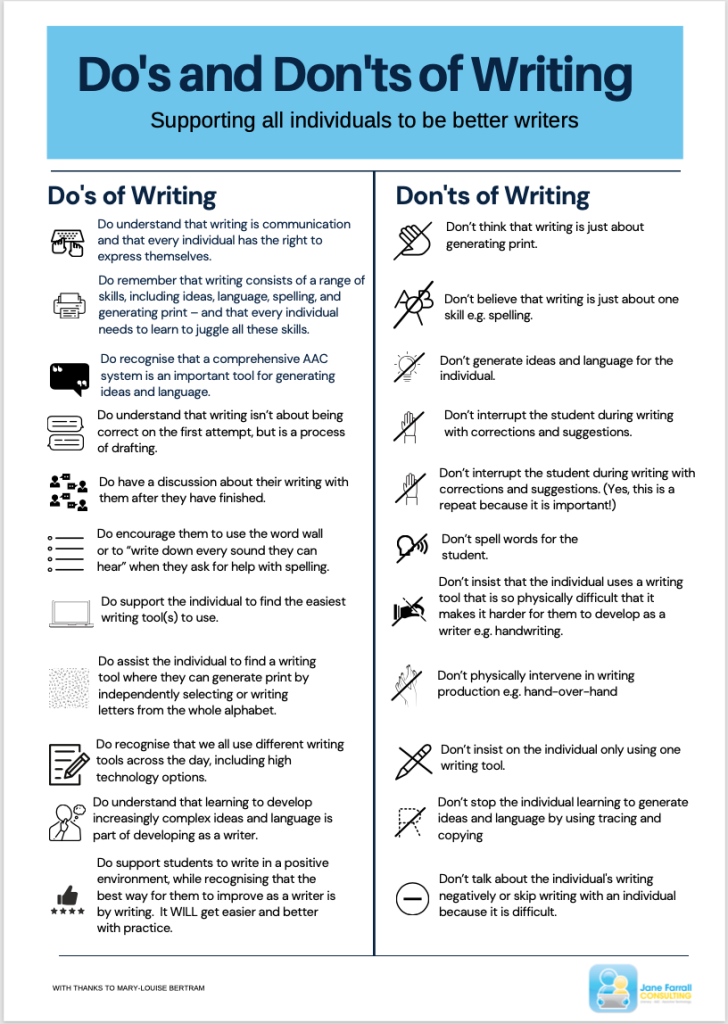
Do’s and Don’ts of Writing
The Do’s and Don’ts of Writing was created as a poster to help everyone remember that our role is to support every student to move to being an independent writer. Writing is a complex skill that involves a number of sub-skills and we need to make sure that our writing instruction supports the development of all of those skills equally.
There are also certain practices that we need to avoid – such as interrupting the student with corrections when they are writing. These are covered on the “Don’ts” side.
Writing Tools
Transitional and Conventional students usually need to use a keyboard – and may also use handwriting. They need access to the whole alphabet as quickly as possible – so we wouldn’t generally use flip charts. There is a whole alphabet flip chart for students using Partner Assisted Scanning that is appropriate for transitional and conventional writers, and in direct access there are just two flip charts on the page of writing tools on comprehensiveliteracy.com that I developed for conventional writers who had specific access needs.
There are also a range of low tech QWERTY keyboards on the writing tools page that are suitable for transitional and conventional writers if needed. In using these, they would generally point to the letters and we would scribe the letters as they select them.
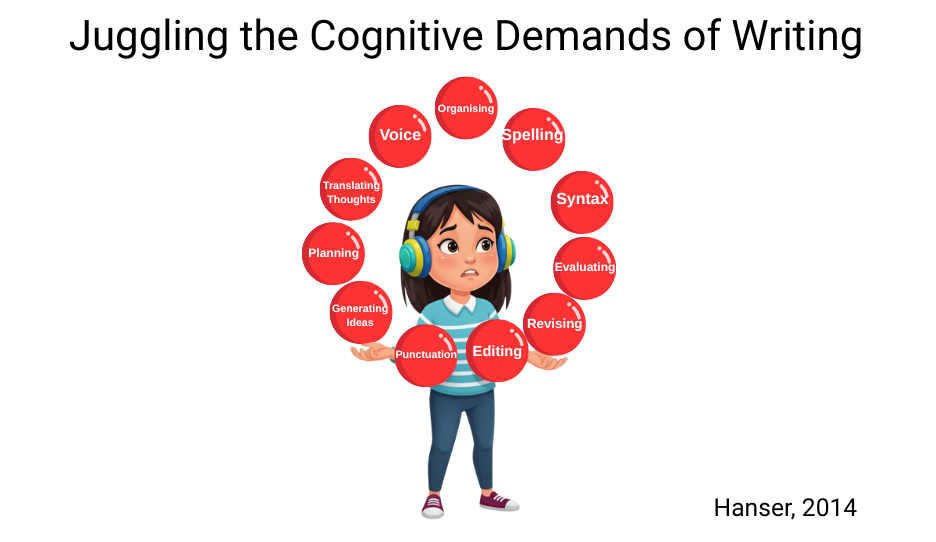
Gretchen Hanser, Occupational Therapist, created the graphic below to demonstrate how many different demands a conventional writer has to think about when they are writing. This graphic only represents the cognitive, or thinking, skills involved.
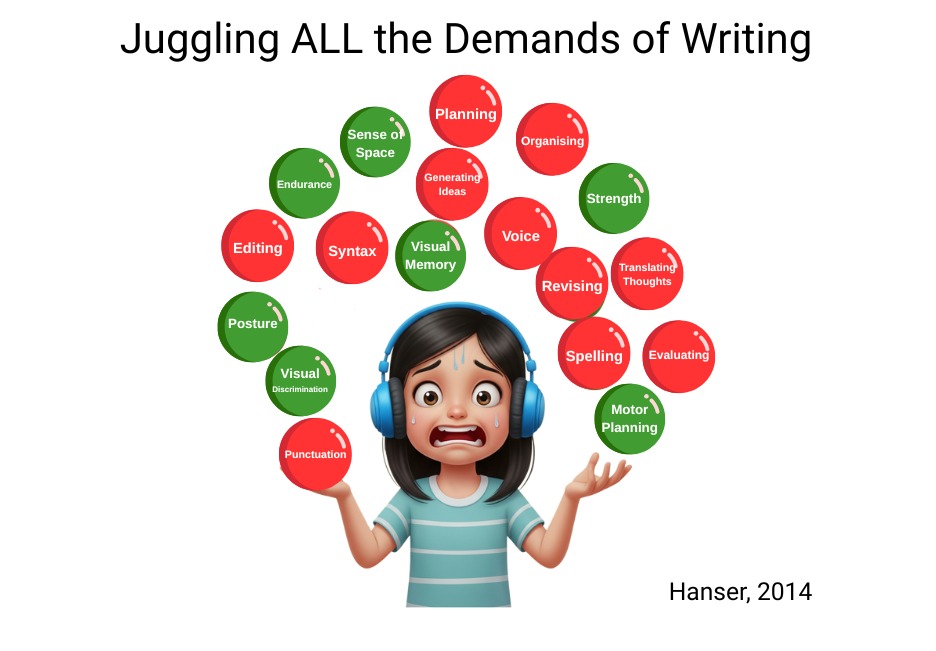
The second graphic, below, shows what can happen when a difficult writing tool is introduced to a student – and why we absolutely need to make sure that they have the easiest writing tool possible for them to continue to keep as many balls as possible in the air.
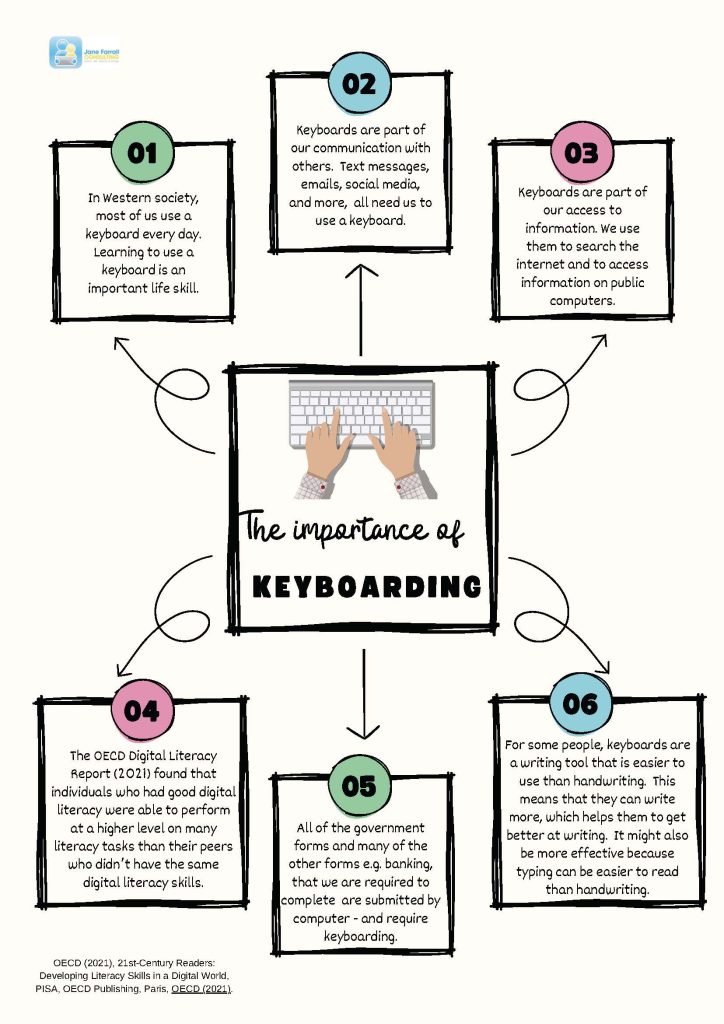
For all students, keyboarding is an important skill to learn for a range of reasons. You can check some of these out below:
One Good Sentence: Let’s Write and Writing Continuum Guide
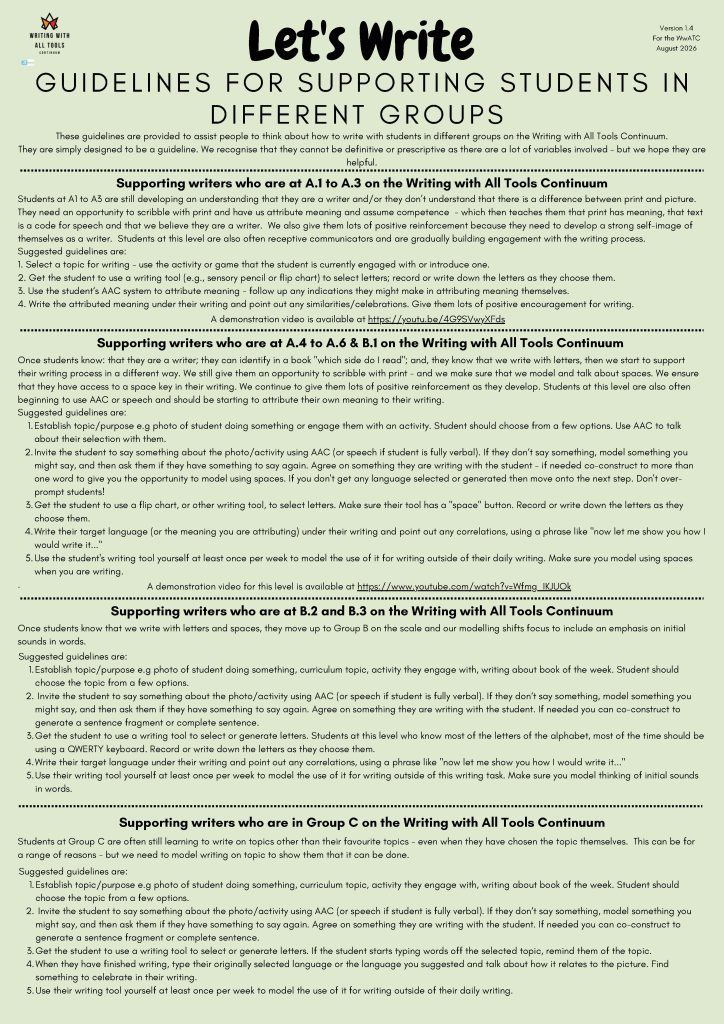
Transitional and early conventional writers need to learn to write one good sentence where they independently generate the language, ideas, words, spelling, etc. We would start by focusing on simple sentences (3 to 6 words). The Let’s Write handout has guidelines for supporting students who are learning to write one good sentence.
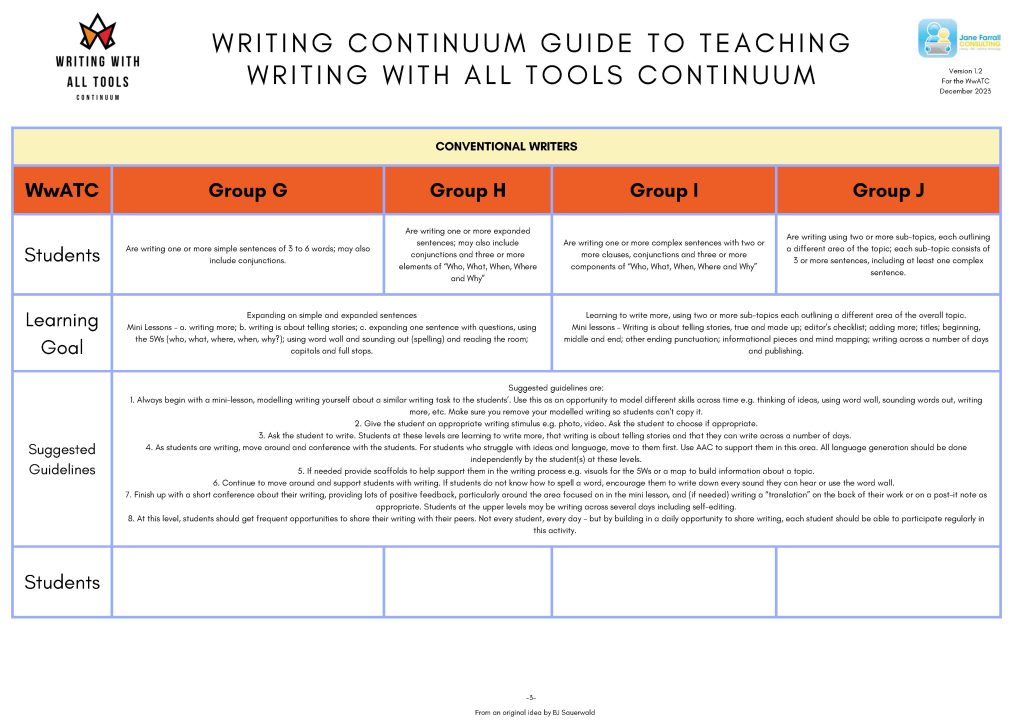
Part of conventional writing instruction is teacher mini-lessons. These are where the teacher models the sort of writing that they would like the student to move towards. Below is a series of suggested mini-lessons for students learning to write one good sentence. This is followed up with resources for students writing more – and more!
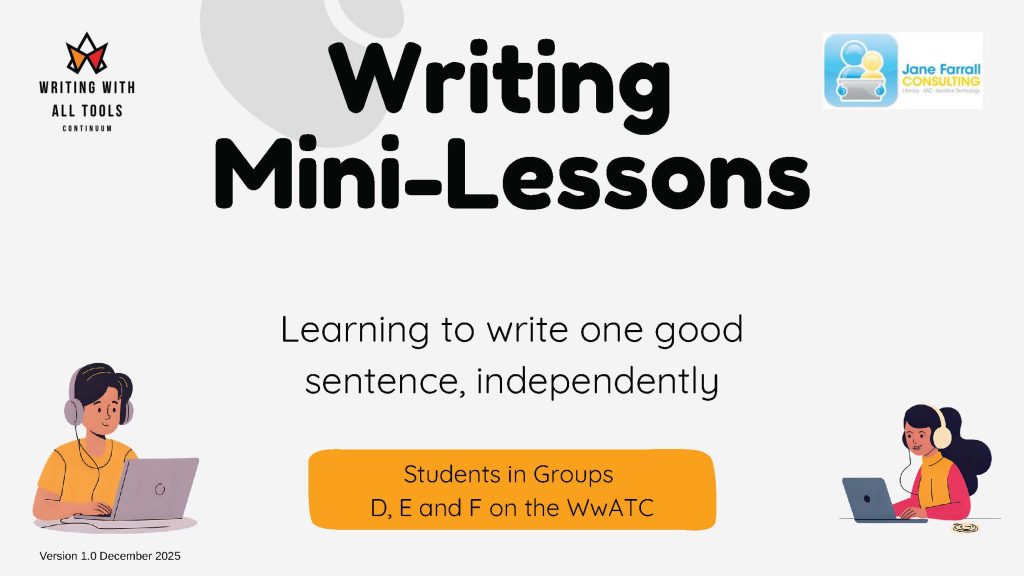
Students at this level may also need extra support around using Little Words. This is referred to in the Mini-Lessons and further documents around this are provided here.
- Little Words document
- Vocabulary Instruction with common little words
- Little words vocabulary instruction cards
Writing Guidelines
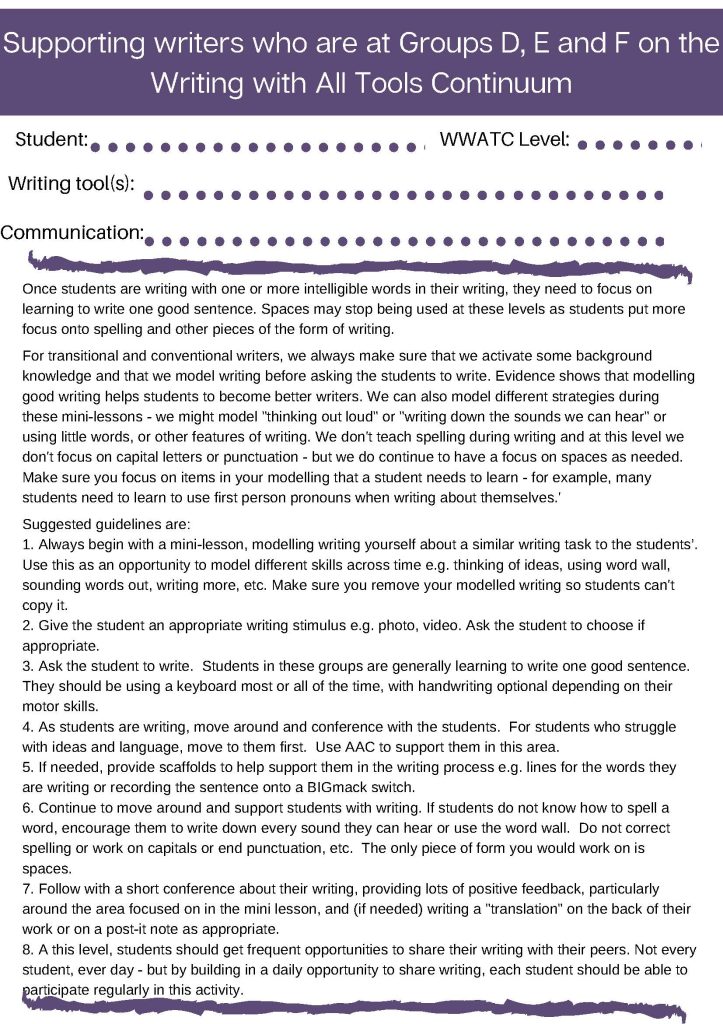
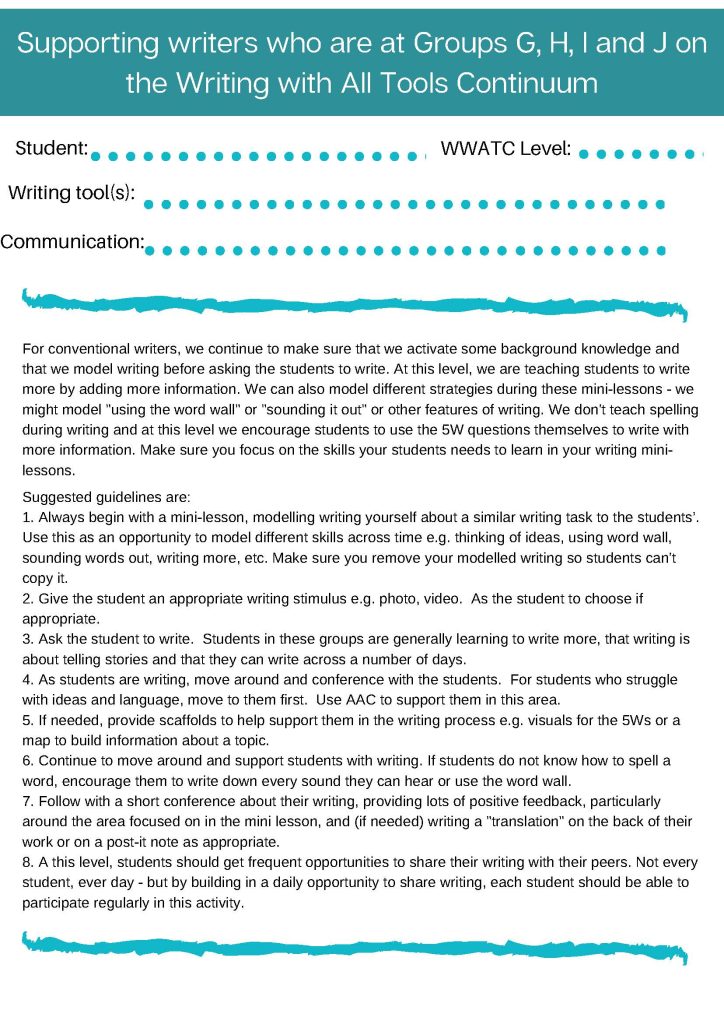
The Writing Guideline Sheets are designed to be placed on the inside front cover of a student’s writing book to help everyone on the team ensure that each student is provided with any writing supports and scaffolds in a consistent way. The sheets are available with guidelines at different levels, the same guidelines that are provided in Let’s Write.
Writing More
Once a student is reliably writing one simple sentence, they need to learn to write expanded and complex sentences. They also need to learn that writing is about telling more, followed by learning that writing is about telling stories. They then continue to become a more complex writer with more modelling and practice.
This set of writing mini-lessons is aimed at students in Groups G and H who are learning to write expanded and complex sentences.
One of the tools that we use for teaching developing writers that “writing is about telling more”, is to teach them that there are five questions that they can ask themselves every time they write. These 5 questions help students to write more, by adding more information. These are known as the 5Ws – who, what, when, where and why. It’s very important that the students learn to ask themselves these 5 questions – we cannot prompt them as independence is the aim.
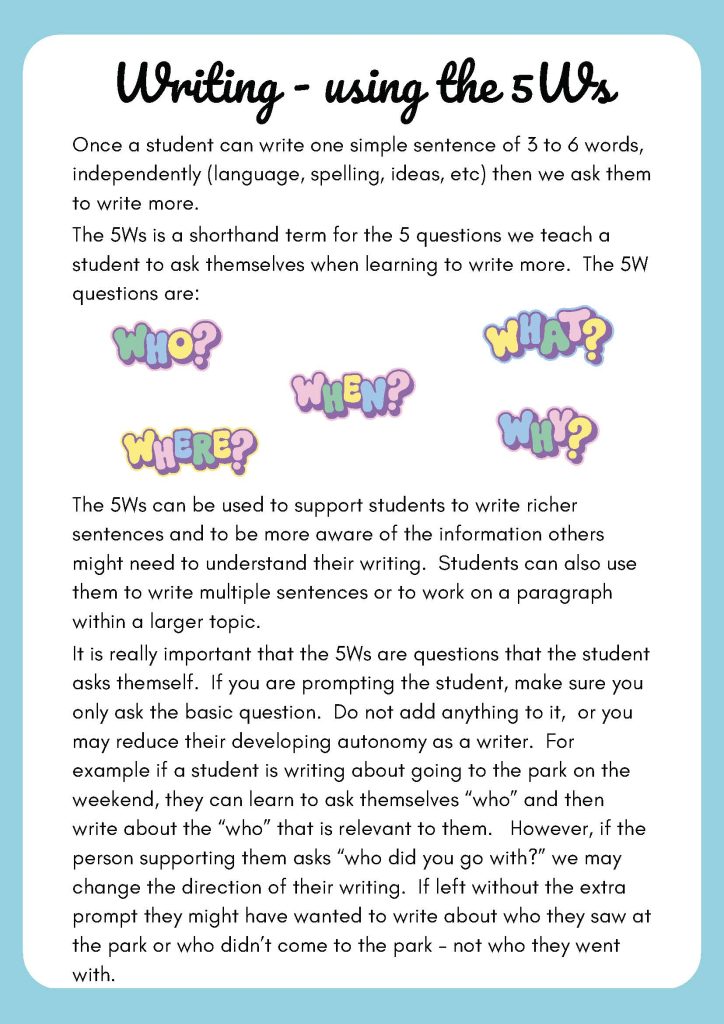
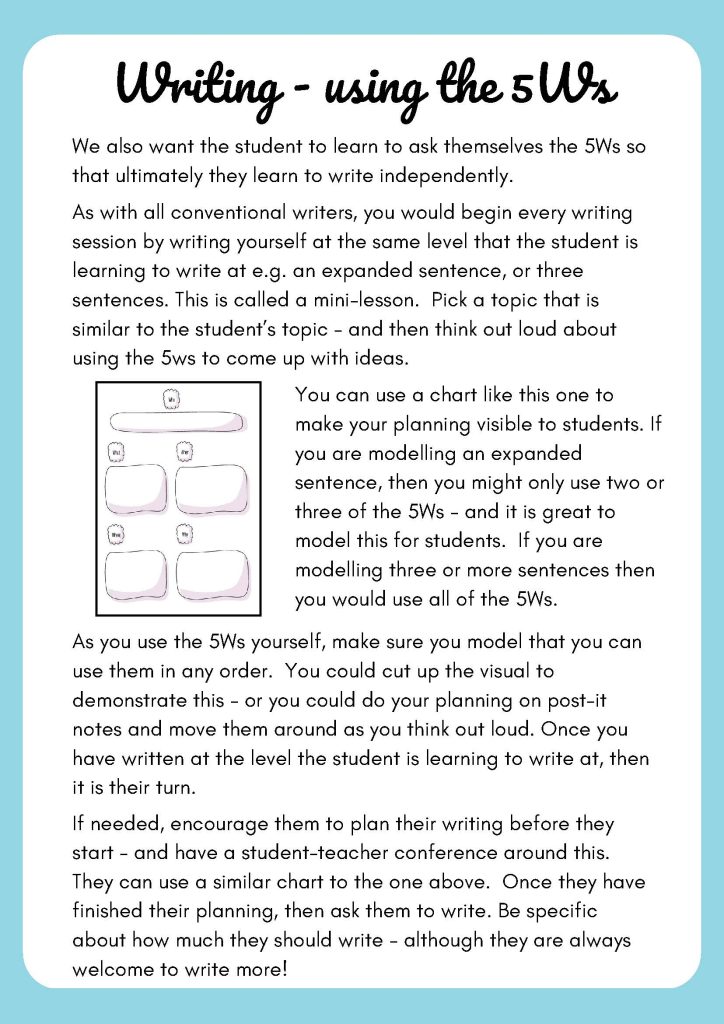

- Writing using the 5Ws handout
- Writing with the 5Ws graphic
- Writing using the 5ws printable planning sheet
- Writing using the 5ws electronic fillable planning sheet (new October 2025)
Editor’s Checklist
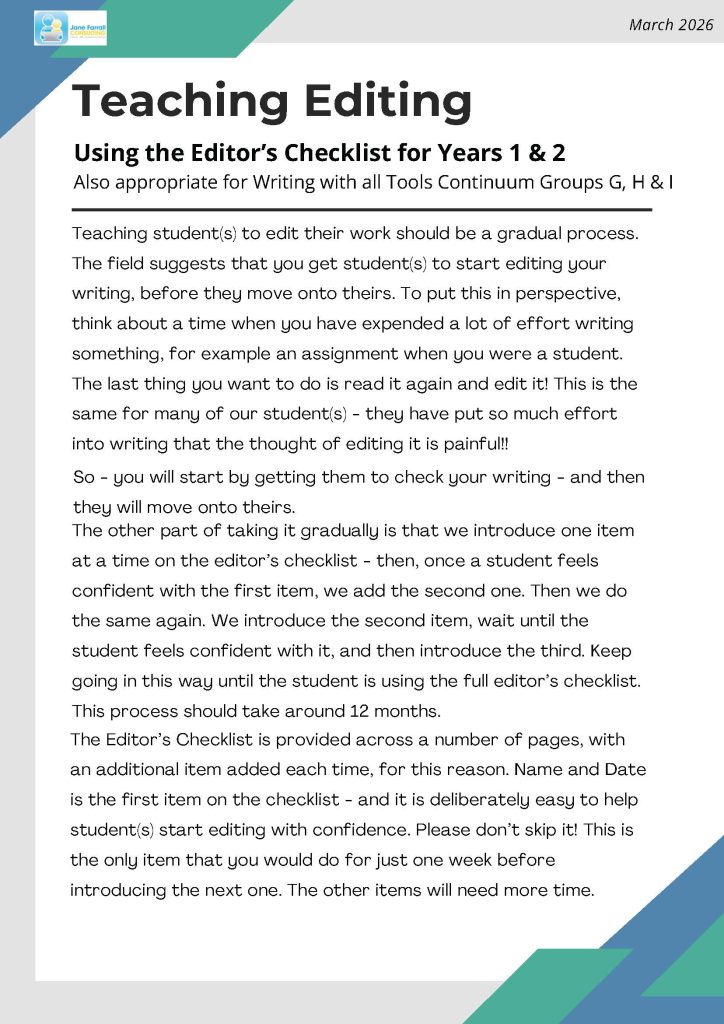
Once students are independently writing one good sentence, which can be understood by their intended audience, we also begin teaching them to begin editing their own writing. The handout below goes through the basics of Teaching Editing.
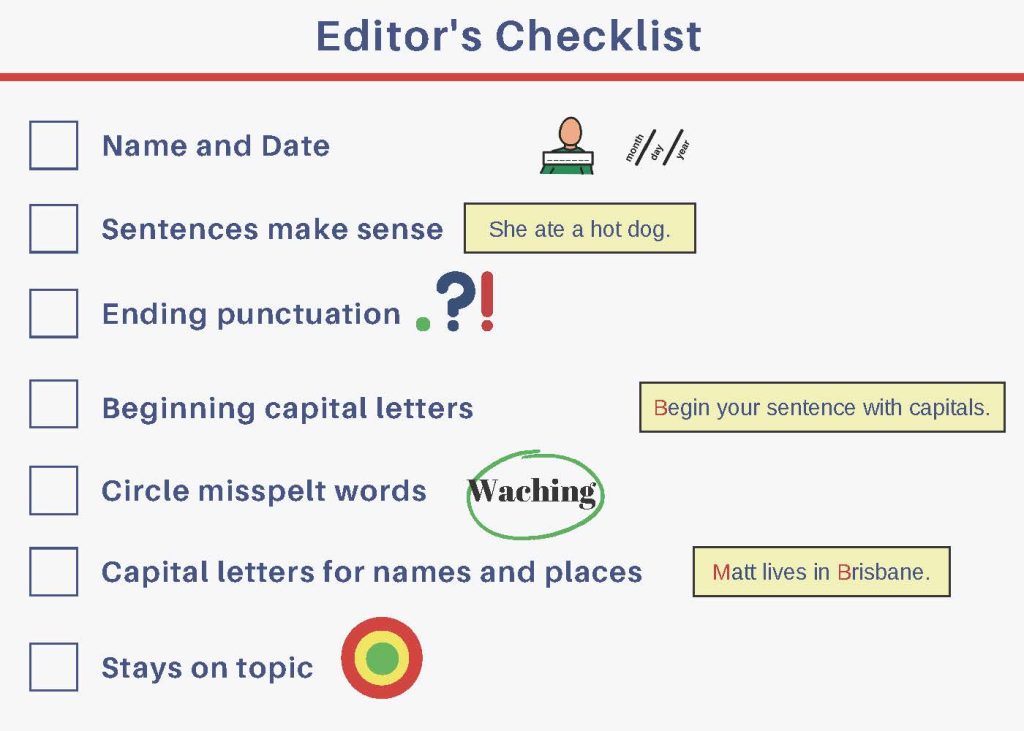
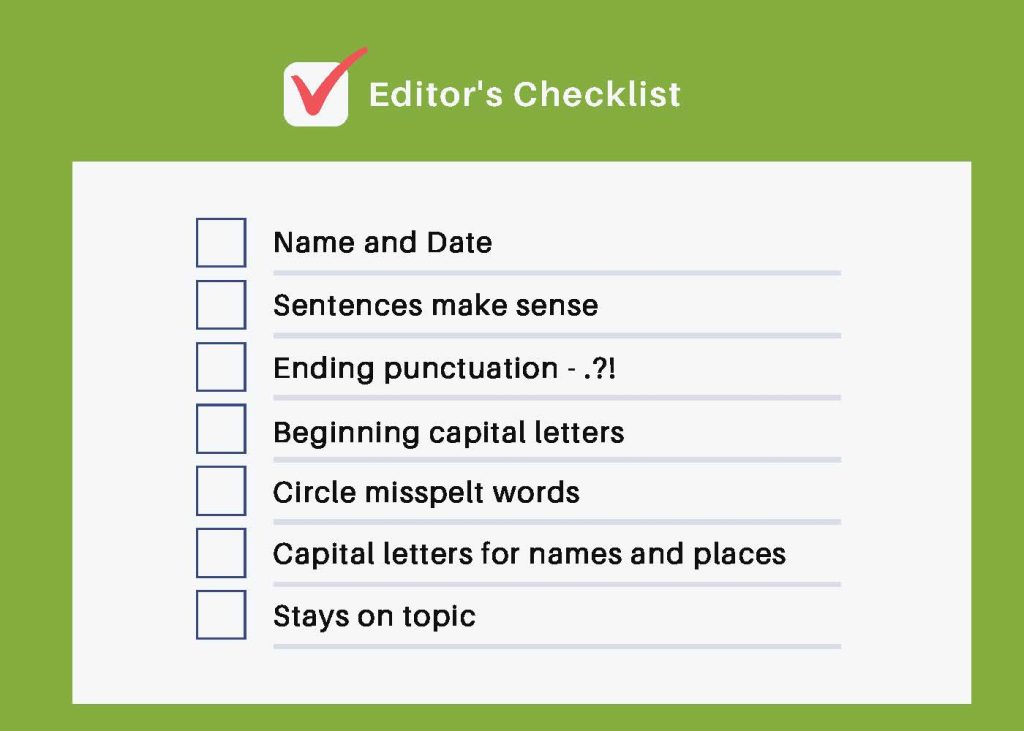
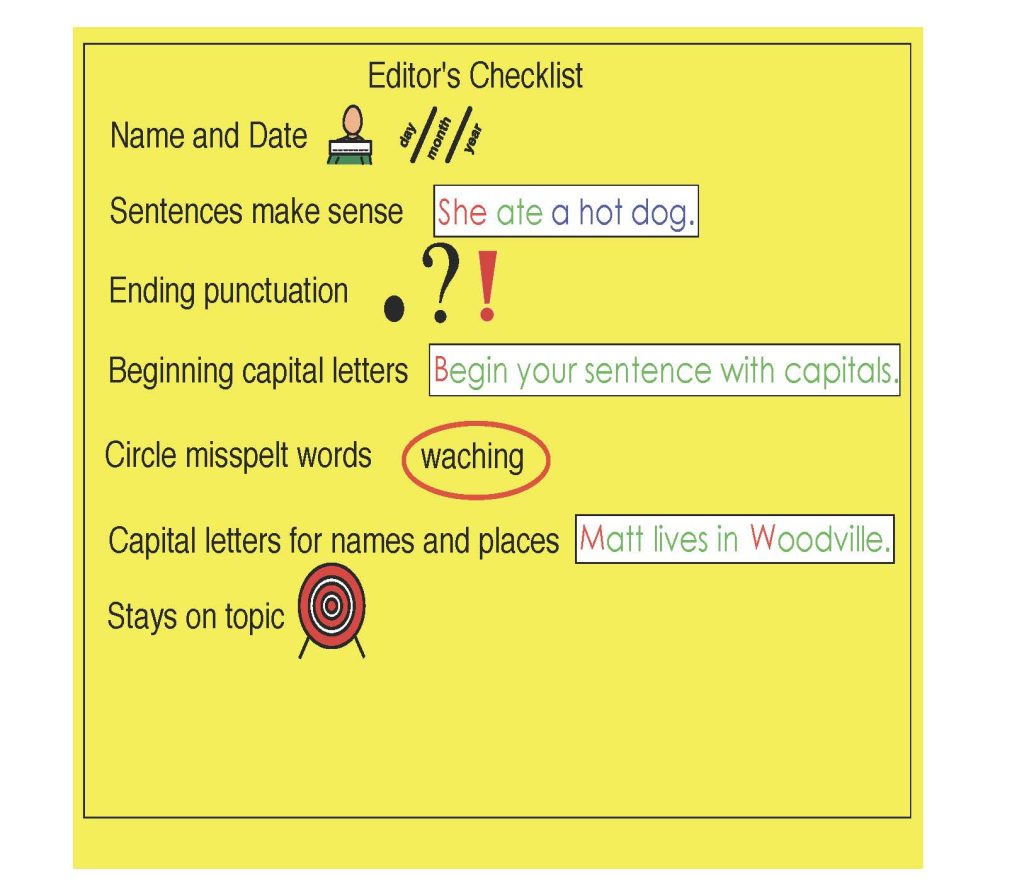
The research into teaching editing tells us that many students struggle to start by editing their own writing. Instead, they do better when they get to edit ours and then transition to editing their own. So, we introduce editing systematically. We create an editor’s checklist of things to check for, adding one item at a time. We explain the first item to the students, ask them to check our writing for that item, and then we transition to them checking their own writing for that same item. Once that has happened, we can add another item to the editor’s checklist and start the process again. Examples of a typical editor’s checklist for a student who is at the level of “learning to write more” are below. The first two items are deliberately simple to help students gain confidence with the editing process.
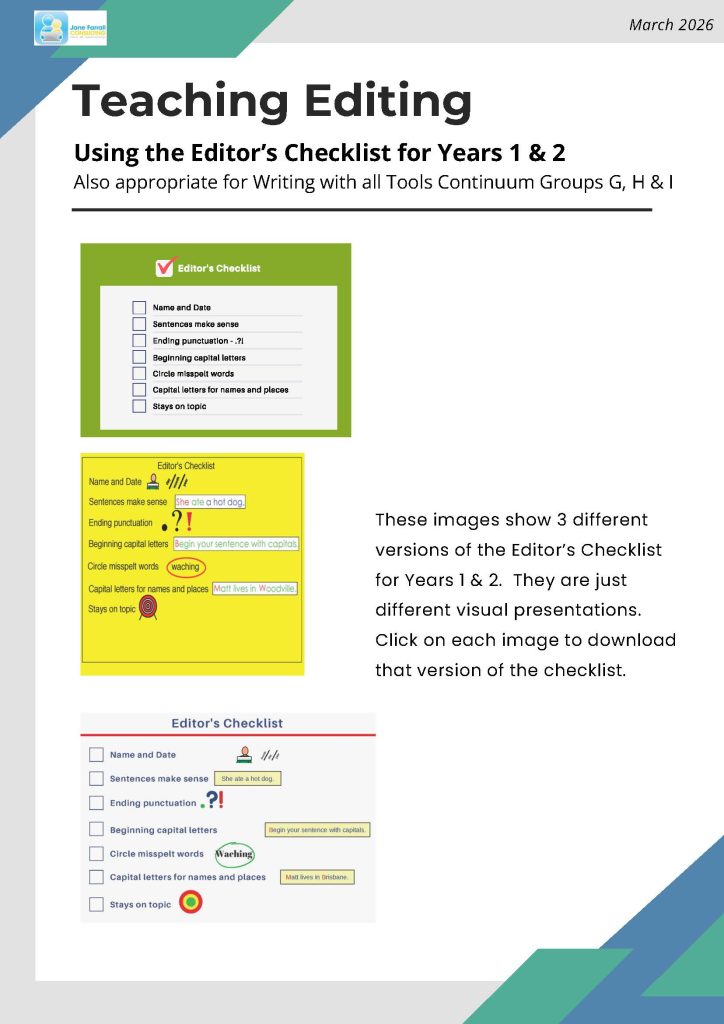
Click below to download resources:
- Teaching Editing handout
- Editor’s Checklists Grades 1 and 2
- Editor’s Checklist example for Grades 3 and 4
For students in groups I and J they are learning to write about more with planning and organisation. This set of mini-lessons is aimed at these students.
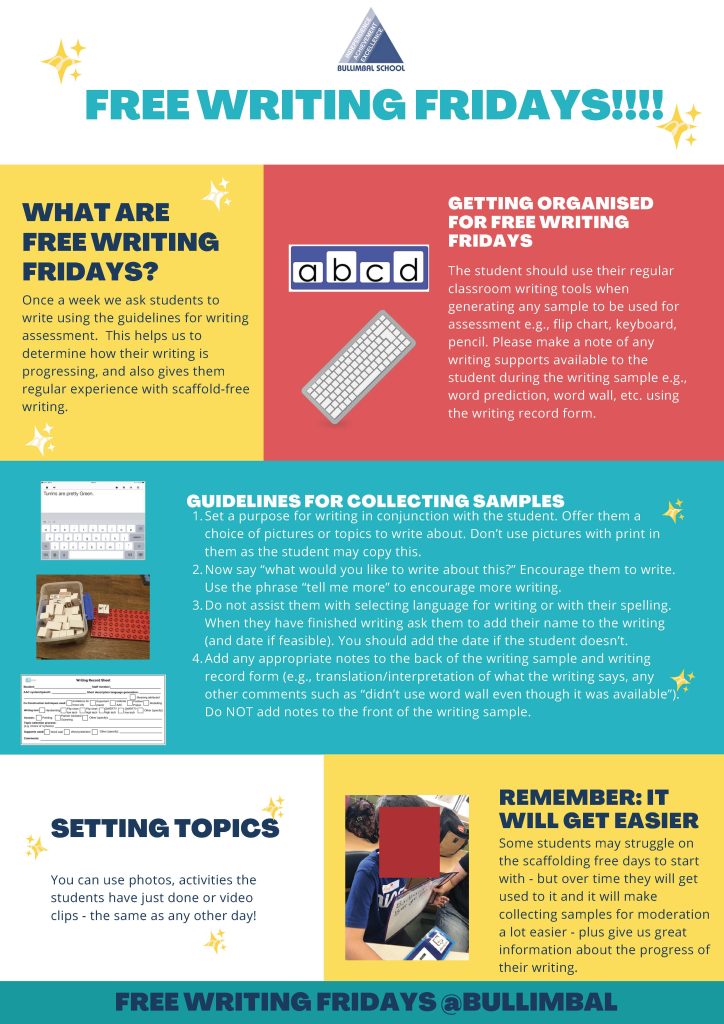
Free Writing Fridays (or Mondays….)
Once a week, we should run a writing session where we don’t provide any scaffolds or supports to our students in writing. This has two purposes. The first is to give students practice in writing in “assessment conditions”. The second, which is more important, is that we get to see how their writing is progressing free of any scaffolds or other intervention. You should use the guidelines for collecting writing samples on this day.
Independent Writing – Other Resources
Independent Writing – General Resources
- Spaces graphics (created January 2023)
- Writing web for planning non-fiction writing – coloured version (created June 2022)
- Writing web for planning non-fiction writing electronic fillable (created September 2026)
- Writing web for planning non-fiction writing – greyscale (created June 2022)
- Writing map for planning beginning-middle-end (created June 2022)
- Writing map for planning beginning-middle-end electronic fillable (October 2025)
- Teaching to the Next Group – document associated with the Writing with All Tools Continuum
Example Lesson Plans created using the model from The Grove Education Centre
- Lesson Plans for Students in Groups D to F on the Writing with All Tools Continuum
- Lesson Plans for Students in Group G on the Writing with All Tools Continuum
- Lesson Plans for Students in Group H on the Writing with All Tools Continuum
- Lesson Plans for Students in Groups I & J on the Writing with All Tools Continuum
Writing in our Classrooms Overview Sheet
- Writing in our Classrooms Overview Sheet (updated May 2026)
Individual Writing Self-Evaluation Forms for Educators
- Printable Writing from Me self-evaluation or observation form (modified February 2024)
- Fillable Writing from Me self-evaluation or observation form