Shared Reading: It’s all about the Interaction

Shared reading is the interactive reading of a book between an adult and student(s).
We start reading with babies almost as soon as they are born. This helps them learn joint attention, provides exposure to a much wider range of vocabulary than we use in day to day communication, helps them to learn about language – and a whole heap of other skills, including how books work! For these reasons and many more, all emergent students will benefit greatly from shared reading. Many transitional and conventional literacy learners also benefit from, and enjoy, having great books read to them.
If you have emergent students in your classroom, you should have a shared reading book of the week. If you have students who need AAC, you would also use AAC in the shared reading interactions that you have each day. Shared reading should also occur with emergent students in the independent reading block – but the difference here is that they get to pick the book! Click here for a blog post which includes some videos that could be helpful. Remember: using AAC throughout shared reading is really important for your students who need AAC as it builds their understanding of language and using AAC.
Shared Reading Levels
The research into shared reading, shows us that adults change their language and the activities they do during shared reading, based on the language level of the individual they are reading with. There are four different language levels that have been identified. The table below shows these four different levels.
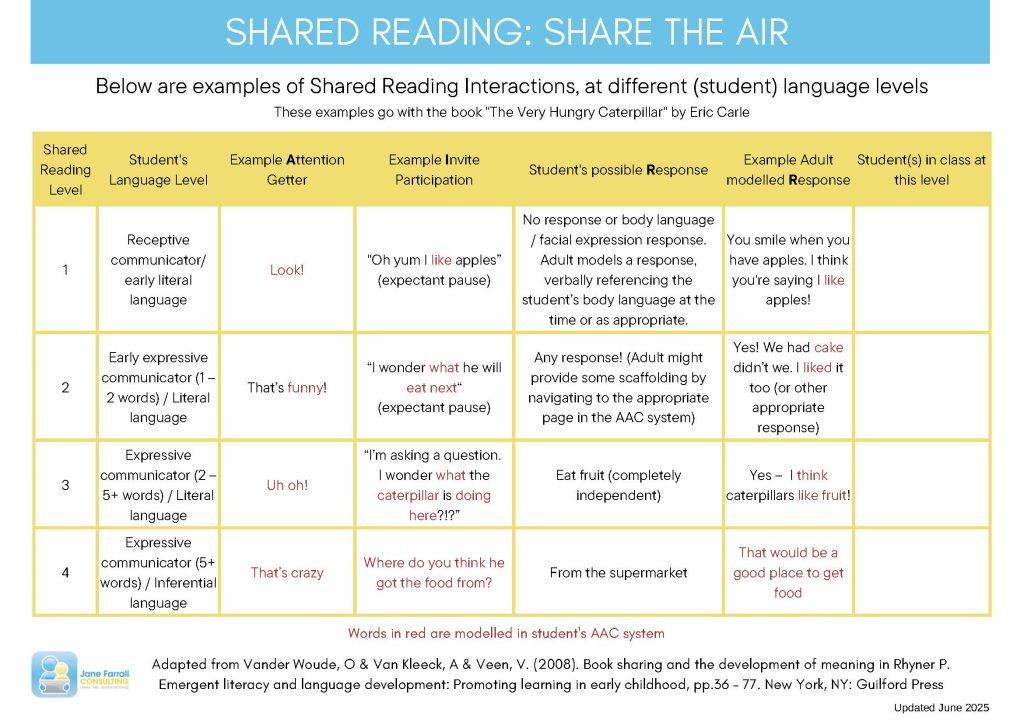
Use the descriptions in the column titled “student’s language level” to decide where each of your students is at. As a general guideline, early emergent literacy learners would usually be at Level 1, emergent literacy learners would usually be at Level 2 and late emergent literacy learners would usually be at Level 3. Transitional and Conventional literacy learners are usually at Level 4.
Share the AIR
With all students we use AIR – we get their Attention, then we Invite participation and then they Respond (or we model a response for a receptive communicator).
- Shared Reading Level 1: For these students, AIR focuses on like/dislike or yes/no questions. These students are often receptive communicators, and we use their facial expression, body language, vocalisations and any other cues that we can to attribute meaning as their response. If there is nothing we can attribute meaning to, then we model a response. It’s important to remember that we aren’t expecting an actual yes or no response from them.
- Shared Reading Level 2: For a student at the second level, AIR moves to more open ended questions. These questions don’t have a definite right or wrong answer and have a focus on the student being successful at participating e.g. what do you think he’ll eat next?
- Shared Reading Level 3: For a student at the third level, the questions can be open ended or have a definite answer. Just remember to keep the focus on the interaction, not on whether the student is right or wrong. The questions should be based on information from the book e.g. How do you think the caterpillar is feeling now?
- Shared Reading Level 4: For a student at the fourth level, the questions can move to being inferential, This means that we can ask questions that they need to use their world knowledge to answer, rather than questions which only use the information in the book e.g. where would the caterpillar find that food? Students at this level are also usually ready for comprehension instruction, and this should take priority over shared reading if you have limited time.
The Great Eight
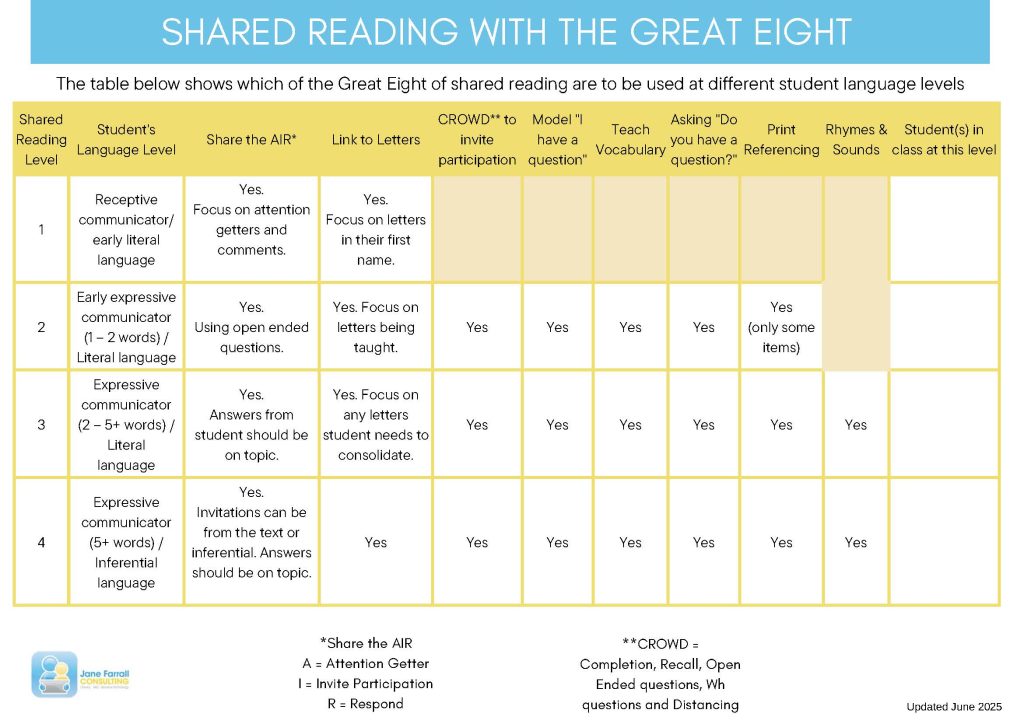
AIR is just one of the activities that adults naturally build into shared reading. The other activities are covered below – and I call them The Great Eight. Just like AIR, these are implemented based on the shared reading level of the student.
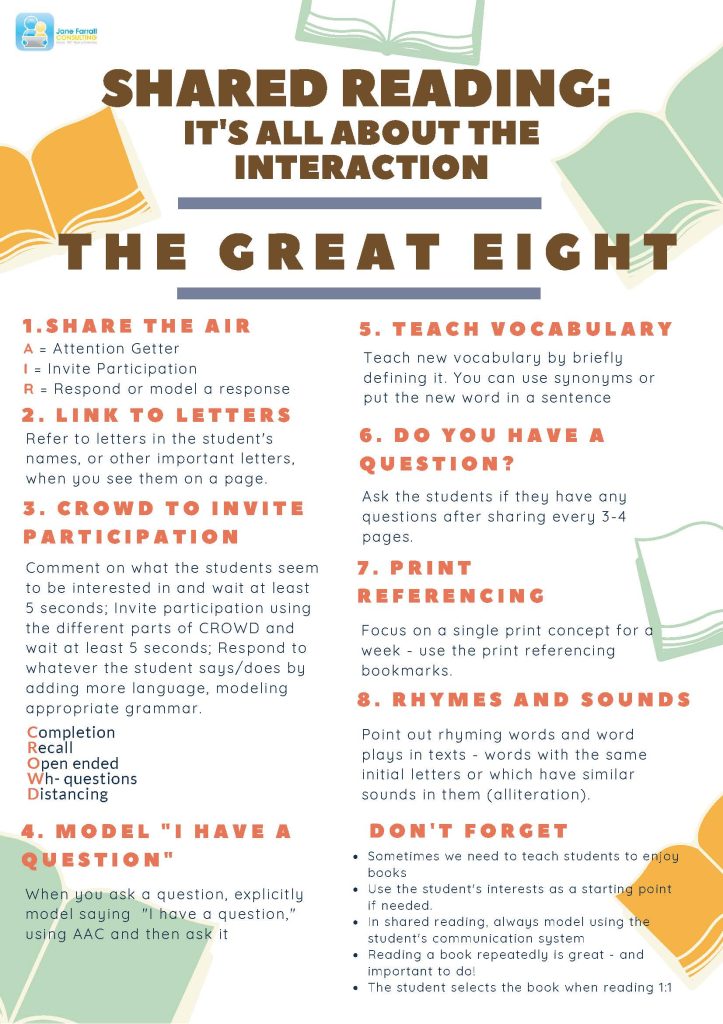
The table below shows which of the Great Eight we should use with students at the different levels of shared reading.
Shared Reading – Other Resources
For a range of resources to help you to implement the Great Eight in your classroom, download the handouts below. And please remember that Shared Reading can happen in a small group or 1:1 – so we often end up doing it with the whole class (with a book of the week) and again with students as a 1:1 activity through the day (with books they select).
Shared Reading General Resources
- Great Eight Poster (shown above and updated August 2022)
- Great Eight poster with more detailed information about language levels (created Feb 2020)
- Shared Reading Language level tables (shown above and updated June 2025)
- Share the AIR poster (for students at Level 1 created Feb 2020)
- Shared Reading record form instructions (created Feb 2021)
- Shared Reading record form for students at Level 1 (updated July 2026)
- Shared Reading record form focus on engagement (also for students at Level 1; more detailed engagement scale; created April 2022)
- Shared Reading record form for students at Level 2 (created Feb 2020)
- Shared Reading record form for students at Levels 3 & 4 (created Feb 2020)
- Shared Reading record form cover sheets (created Feb 2021)
- Reading record form (created March 2020)
Example Lesson Plans created using the lesson plan model from The Grove Education Centre
Jane and Sally Clendon’s Pinterest boards around shared reading books
- Favourite shared reading books
- Books for early emergent students
- Picture books for older readers
- Great shared reading books by Aboriginal authors and/or illustrators
Shared Reading Self-Evaluation Forms for Educators
- Printable Shared Reading self-evaluation or observation form (modified February 2024)
- Fillable Shared Reading self-evaluation or observation form
- Engaging and Interactive Book Reading From Staff (a simpler form, which some schools have used with teacher aides or teachers)
Shared Reading in our Classrooms Overview Sheet
- Shared Reading in our Classrooms Overview Sheet (updated May 2026)
Shared Reading Guides
These guides are designed to support new staff to do shared reading with students at Level 1. They have a focus on staff learning to use AAC systems and on modelling language rather than asking questions.
- Overall instruction sheet
- Shared Reading Guides with PODD (designed for a Group PODD)
- Shared Reading Guides with SimPODD (designed for a Group SimPODD)
- Shared Reading Guides with Proloquo
- Shared Reading Guides with Proloquo2Go (designed for the 7 x 11 layout)
Shared Reading Cards
These cards are designed to support new staff to do shared reading with students at Levels 2 and 3. They have a focus on staff learning to user AAC and on asking open ended questions. For students at Level 2 we would accept any answer. For students at Level 3, we would scaffold them to answer on topic.
- Overall instruction sheet
- Shared Reading cards with PODD (designed for a Group PODD)
- Shared Reading cards with SimPODD (designed for a Group SimPODD)
- Shared Reading cards with PODD 15+ School (designed for electronic PODD systems)
- Shared Reading cards with Proloquo
- Shared Reading cards with Proloquo2Go (designed for the 7 x 11 layout)
Print Referencing / Print Concepts
- Print Referencing A4 sheets (updated Aug 2024)
- Print Referencing bookmarks (updated Aug 2024)
- Print Referencing Bookmarks record form (updated March 2026)
- Informal Print Concepts checklist (created Nov 2022); use no more than once per term to check progress in student’s print concept knowledge. Also available under Assessment.
Shared Reading Blog Posts from Jane Farrall
- Somebody’s Land: Shared Reading
- Shared Reading: Book Week 2021
- Book Tips for Older Readers
- Shared Reading: Let’s Be Interactive (recording of a conference keynote)
- Zombies and Independent Reading
- Shared Reading – Keep the Interaction Going
- Reading at Home
- AGOSCI 2025 Day 3: Developing Print Concepts